Editor’s note: Gareth Riley-Ayers’ parents met while attending Morehouse and Spelman colleges, and he grew up in College Park and Buckhead until heading off to college and working as a consultant in Washington D.C. (before circling back home). So, Atlanta is quite literally in his blood. He works for FEMA, preparing disaster budgeting and organizational development, and he has ideas for applying practical solutions to a place he thinks about often: the entirety of downtown Atlanta.
One intersection in particular, Riley-Ayers posits, should be freed from the confines of its reputation and past precedents, with multiple nearby blocks showing examples of how it can be done. He writes:
...
Dear Editor,
I’m an Atlantan that deeply believes in Atlanta. I am also acutely aware of our failures and how that impacts individual lives and communities.
Consider this: Strategic Goal 3.3 of the Downtown Atlanta Master Plan, published in 2017, describes “Grow[ing] Downtown Neighborhoods by Reimagining Critical Sites,” with the Gulch and Underground Atlanta named as “priority projects.”
This past summer, the results were realized as global eyes, feet, and wallets came to downtown for the 2026 FIFA World Cup.
The FIFA Fan Fest in Centennial Park, rallies for Argentina in Underground Atlanta, and perfectly pulled Guinness pints at The Irish Exit in Centennial Yards are evidence of a plan successfully coming together.
But it’s not enough.
As Mayor Andre Dickens often states: “Atlanta is a team sport.” And that was proven true by the biggest World Cup surprise, in my opinion—South Downtown.
The venture led by David Cummings and Jon Birdsong built a platform for Atlantans to rediscover the historic heart of our city. Their South Downtown investment organization reimagined long-abandoned buildings and storefronts, mostly along Mitchell and Broad streets, attracting Atlantans and future World Cup champions, Spain, to their Casa España “home base” near Founders Green.
But again, that’s not enough.
Downtown investors agree. Tony Ressler, co-owner of Centennial Yards, stated to the AJC in 2024, “a vibrant downtown is what this is all about… successful Centennial Yards will lead to other successes around downtown.” In a post-World Cup interview Shaneel Lalani, Underground Atlanta’s owner, stated: “We need to keep our foot on the gas… the job’s not done.” Even Birdsong has continued pushing to reimagine South Downtown despite staff reductions.
Investors recognize a lot of work is still needed before downtown makes sense as an everyday, aspirational place for metro Atlantans. Much like Centennial Yards, Underground Atlanta, and South Downtown, another “critical site” needs reimagining to support intown livability post-World Cup: the intersection of Peachtree Street and Memorial Drive.
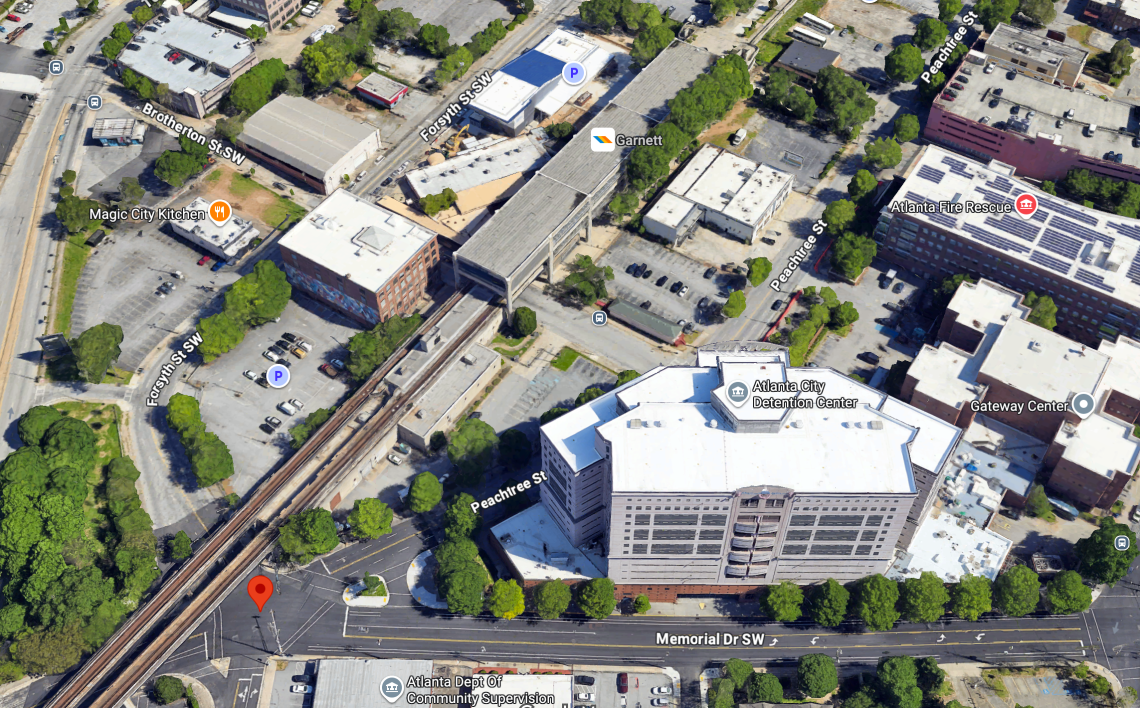 Current uses and MARTA proximity around the Peachtree Street and Memorial Drive intersection downtown. Google Maps
Peachtree, our most famous street, connects northside commerce and culture. Memorial Drive similarly links eastside neighborhoods to historic Oakland Cemetery, East Lake Golf Club, and an ambitious, reinvigorated greenway proposal. These roads meet in our city center—five blocks from the Georgia State Capitol and five blocks (as the crow flies) from Centennial Yards.
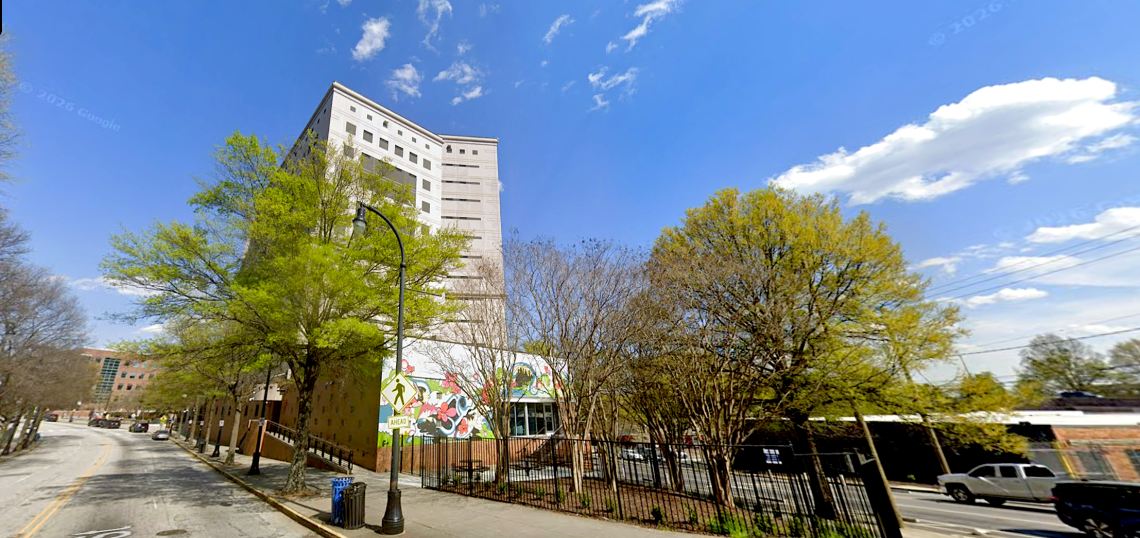
Standing at this nexus of north and east Atlanta is the 17-story Atlanta City Detention Center, an inefficient use of space and a failure of imagination.
This city jail finished construction just before the 1996 Olympics, showing our capacity to control crime. Now, taking the downtown Connector to Interstate 20 west, one sees Grady Hospital, the Gold Dome of the Capitol, and the Atlanta City Detention Center. These buildings, each central to our city, show what we believe about ourselves. And once on the world stage, our oldest streets held a monument to locking up Atlantans. How embarrassing.
Right now, the future of the ACDC is being negotiated by the City of Atlanta and Fulton County. In October, the Atlanta City Council voted 8 to 7 approving mayoral negotiations for the sale of the facility to the county. Currently, county detainees are held at the federally condemned Rice Street Jail, with additional leased beds at the ACDC reducing overcrowding. A $68-million transfer of the facility eases pressure on Fulton County during federally mandated improvements to Rice Street. But concerns about the sale were expressed by Councilmembers Michael Julian Bond and Antonio Lewis, who specifically noted the root cause of Fulton County’s issues aren’t being addressed.
Dickens describes the pending sale as a win for everyone involved. County Commission Chair Robb Pitts agrees, stating, “I can’t think of a more ideal situation for Fulton County and the City of Atlanta.” But imagine the benefits to Atlantans, downtown investors, and our traffic if Peachtree and Memorial wasn’t a place people avoided.
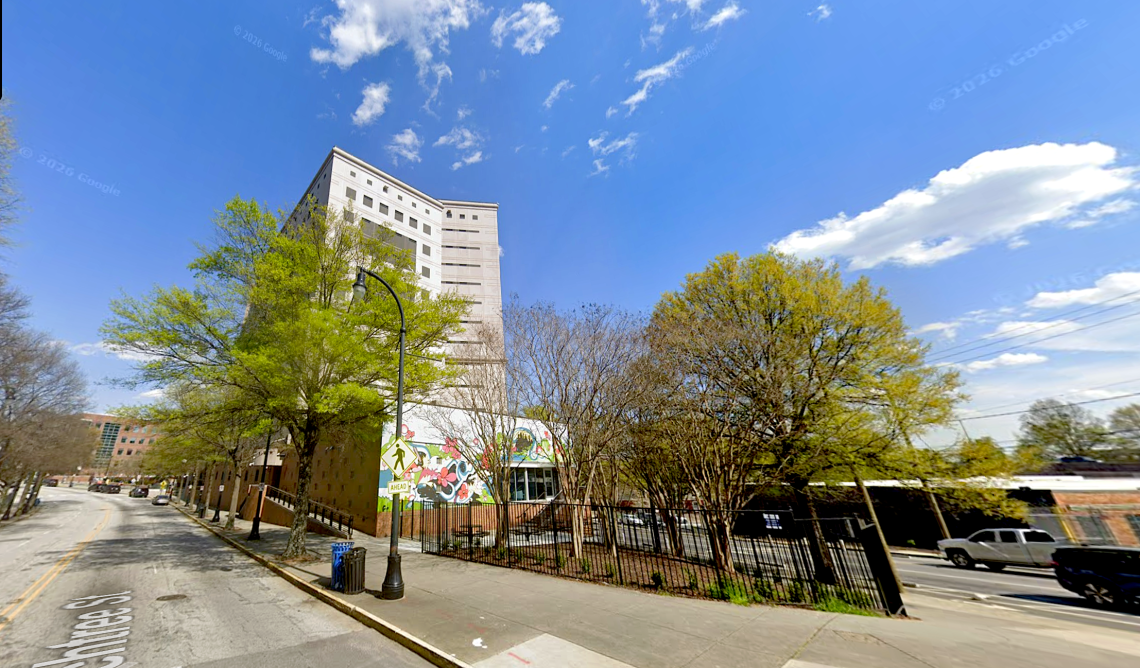 ACDC's stance over the intersection in question today. Google Maps
Like other “critical sites,” a reimagined, prison-free Peachtree and Memorial could grow a day-to-day vibrancy for downtown. Back in 2017, “Fears about my safety” was surveyed as the second highest answer to “[dislikes] about downtown Atlanta.” Stopping crime is complicated, but removing prisoners and crime-related businesses is a start. Without the jail, bail bondsmen, and supporting parking lots, the intersection could open for investment with three MARTA stations, a multitude of government buildings, and 40,000 Georgia State University students nearby, and more.
Peachtree and Memorial should be a place of pride for Atlantans. Removing the prison begins that story.
After the ACDC, downtown should reemphasize its story as a hub for public work and government coordination. Atlanta, as the Capitol of the South, is home to around 294,000 government employees, according to the Georgia Department of Labor, and 70-plus foreign consular/trade offices. Current public buildings need repairs, so commercial real estate and the government should collaborate to reimagine mixed-use spaces, concentrating these public offices downtown. Each government facility requires 24/7 security, which would increase police presence and a sense of safety for everyone.
Imagine the impact of a co-located GBI, Department of Public Safety, and Atlanta FBI Field Office on the story of downtown’s crime. Additional parking wouldn’t be needed, thanks to public employee transit benefits and multiple MARTA stations. Every employee downtown is one less car in rush-hour traffic. And increased MARTA revenues mean increased MARTA performance and safety investments. Finally, an enhanced government corridor near the Capitol would improve coordination, problem-solving, and service delivery, while reinforcing safety and livability.
Let’s not forget what Atlanta Police Department Chief Darin Schierbaum has recently stated: “You can’t arrest your way to a safe city.”
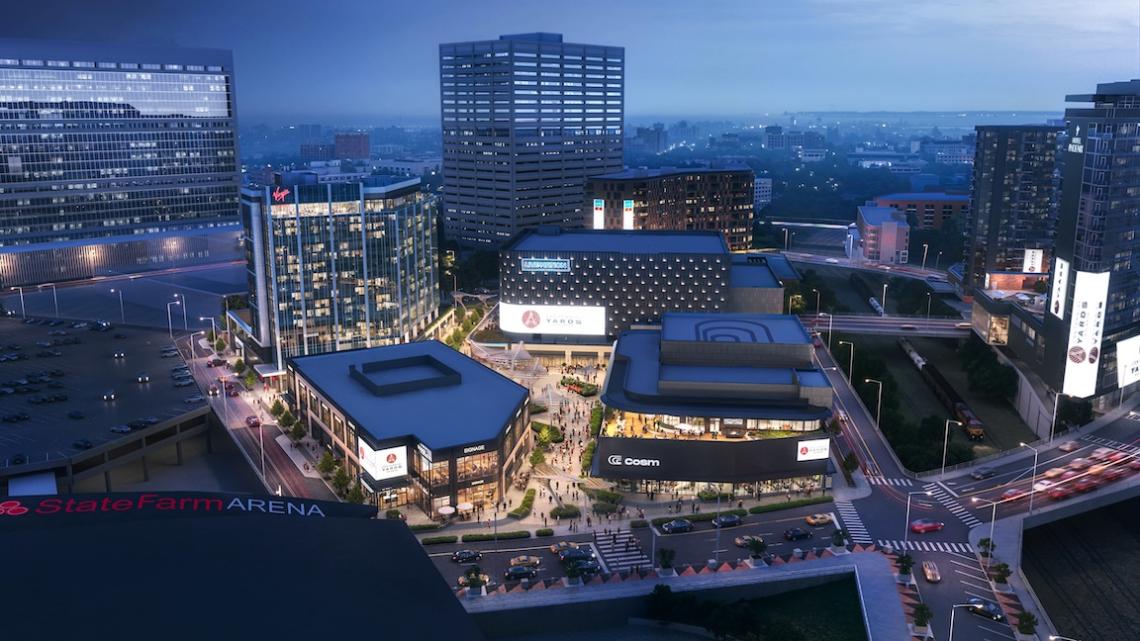 Overview of the 7 and 1/2-acre Entertainment District coming together in downtown Atlanta's former Gulch, with Cosm shown at center. Courtesy of Centennial Yards
Atlanta has repeatedly shown the ability to host world-class events. After the ACDC, let’s lean into that advantage. Boston’s Charles Street Jail was a blight on prime river real estate until its 1990 closure. Now a luxury hotel and restaurant, it anchors development. For Atlantans that quality-of-life story could include rebuilding a modern Peachtree Arcade or Grand Theatre. Abu Dhabi built a $600-million museum in partnership with the Louvre, attracting millions. Atlantans brought whale sharks and penguins to live downtown; with our France art partnerships—why not Louvre Atlanta?
Our city motto, “Resurgens” (Latin for rising again), appropriately fits this proposed jail-turned-museum idea, after all.
Let’s change the story. Free Atlantans to pursue happiness all across downtown. When downtown works, intown neighborhoods and the suburbs work, too.
Frederick Douglass High School students from the Westside should be able to study in the AUC or at Georgia State, find a good job downtown, and live in Centennial Yards with their partner. Artsy North Atlanta High School kids should be able to work at a Peachtree and Memorial bakery or bar while living in a group house. Both should be able to live these lives and visit their parents without a car.
So yes, let’s free Peachtree and Memorial. Our city center shouldn’t be bound to crime. The City of Atlanta and Fulton County should finish the plan our newly elected governor set in motion in 2019 and move the ACDC.
— Gareth Riley-Ayers, Atlanta
...
Follow us on social media:
Twitter / Facebook/and now: Instagram
• Downtown news, discussion (Urbanize Atlanta)