Editor’s note: Casey Stokes, Industrial Media Relations vice president, chimes in with the following Letter to the Editor as part of our continued coverage of the proposed $3.5-billion Beltline rail project that’s sparked fierce advocacy and opposition.
…
Dear Editor,
This year, three AJC articles by Atlanta’s wealthy elites have opposed the Beltline rail project that Atlanta overwhelmingly voted for in 2016 and has paid nearly a billion dollars in taxes for.
Each article opposing Beltline rail misrepresents the facts to fit its narrative, and each author has conflicts of interest that influence their appeals to redirect Atlanta’s tax dollars to other projects.
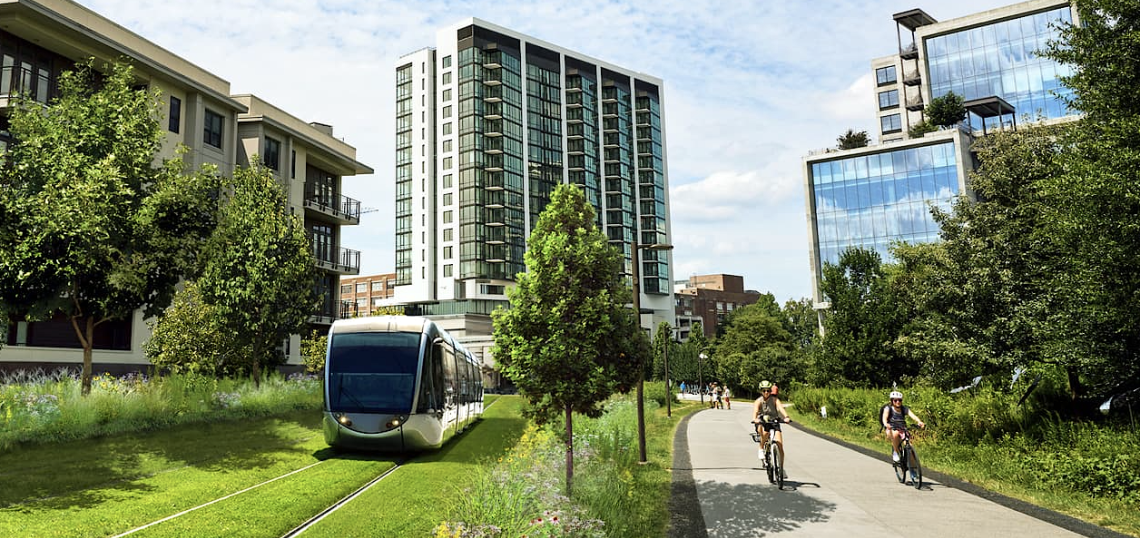
Alex Taylor, CEO of Cox and an heir of the Cox empire, penned an op-ed opposing Beltline rail in May that claimed the transit system would pave over the Beltline’s greenspace, while advocating for thousands of autonomous Rivian cars. His claims starkly contrast with the actual decades-old Beltline build plan of rails on grass.
Adding thousands of automated cars to traffic while charging users high per-trip prices isn’t a transit solution that can handle thousands of riders per hour like rail; it’s a tax-funded Rivian car service. Taylor makes no mention of his conflicts of interest, though the article’s footer was edited, without a revision note, a week after publication to include that Cox has invested $350 million in Rivian.
More recently, Eric Tanenblatt’s article promotes a vision of autonomous shuttles, while claiming light rail is outdated technology that would take decades to build. Despite his career experience, his article ignores passenger capacity, Atlanta’s existing build plan, and the modern, efficient light rail systems being deployed globally.
He also doesn’t mention his conflicts of interest. The AJC bylined Tanenblatt as Global Public Policy & Relations Chair at Dentons, but Dentons’ 2026 Autonomous Vehicles report lists him as Head, Global Autonomous Vehicles and Principal, Washington DC and Atlanta. Even a decade ago, Tanenblatt played a key role in the Georgia Department of Transportation report that planned the roadmap for driverless cars and promoted autonomous vehicles.
Doing the actual math
Bahman Irvani’s recent article advocates for electric buses. Citing a PDF he compiled himself as a source, the article uses questionable methodology to make many unsupported cost claims and debatable calculations.
His analysis, I would argue, is deeply flawed in its time scales, fact-checking, and level of detail.
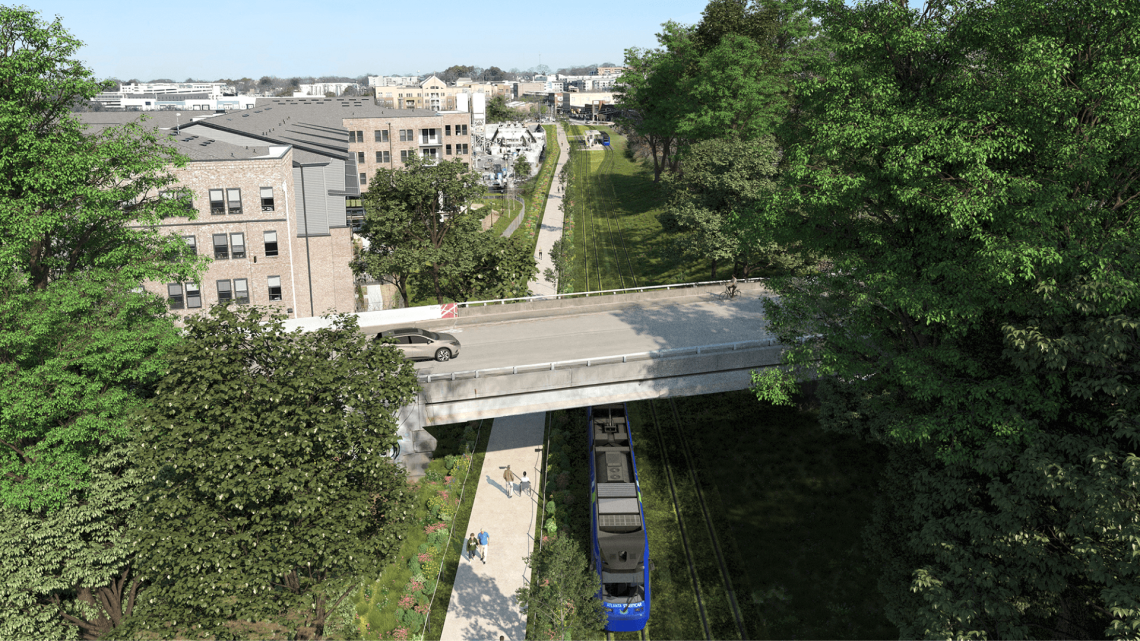 Potential look and functionality of light-rail transit under the Berne Street bridge, next to the Beltline's new Southeast Trail.Kimley-Horn; via ABI
For example, the sources he cites contradict his calculations: They list an average cost of more than $1 million per electric bus, while Irvani uses $800,000 per bus.
He conflates tax-derived infrastructure funding with corporate debt-service funding, inflating the capital cost with 4 percent interest as if the project were built with a 50-year loan.
Irvani then scales Atlanta Streetcar costs into an indefensible operating-cost projection for a complete rail system, ignoring the planned system’s details, economies of scale, and real-world examples of similar systems.
He also arbitrarily reduces initial ridership from a 4.2-million annual projection in the source material to 1.9 million riders, a figure the Atlanta Beltline Inc. sources do not support.
ABI’s analysis that 55 percent of rail trips could involve future MARTA infill stations does not mean 55 percent of rail trips would not occur without the infill stations, as Irvani attempts to assert.
Even if you accept Irvani’s improper reduction in initial ridership, and his misunderstanding of upfront system capital costs, he keeps annual ridership static while scaling costs upwards over 50 years, which assumes zero population growth in Atlanta over the next half-century.
Without scaling up ridership and capacity requirements over the same timeframe, Irvani’s analysis misrepresents both rail and bus costs and ignores the traffic and cost implications of scaling bus systems equally.
Instead of using the same flawed methodology from his rail analysis for his bus numbers, he compares his inflated 50-year cost for a rail system (construction, stations, maintenance facilities, operations, and vehicles) against the purchase cost of new buses alone, conveniently leaving out new bus maintenance facilities, stations, charging infrastructure, and the tax costs of hundreds more large road vehicles on our streets.
He doesn’t even attempt to compare systems with equal, interchangeable capacity. Irvani takes MARTA’s bus operating costs and adds them to his chosen bus price. He ignores all the infrastructure needed to replace passenger rail with hundreds of buses.
His analysis also omits the cost to replace buses every eight to 12 years. Railcars typically last 30 years, and some MARTA railcars have been in service for up to 50 years. He compares MARTA buying hundreds of buses to operate for 12 years, with no plan for infrastructure, to a fully built rail transit system that can move thousands of riders per hour and scale for 50-plus years.
That’s far from an apples-to-apples comparison.
To match the capacity of a 300-passenger train arriving every five minutes, you need a 60-person bus to arrive and depart every 60 seconds (five buses in five minutes). Is that practical, or even feasible? How would hundreds of new MARTA buses circling downtown relieve traffic and scale over decades?
Ignoring bus-infrastructure realities and long-term capacity-scaling issues reflects an unserious approach. This questionable methodology and gross oversight of detail from a gentleman who asserts in his article: “I can read, add, multiply and divide. Everyone should, before adopting a position on the viability of building rail on the Beltline.” He apparently didn’t expect anyone to check his work.
Rail infrastructure lasts decades, has substantially lower annual operating costs per passenger mile, and guarantees affordable, reliable transit for future generations. Settling for a cheap bus system now creates more traffic and costs more in the long term. Atlanta residents have already experienced bus service reductions; we don’t need a system that MARTA and City Hall can cancel on a whim.
Following his peers, Irvani omits his conflicts of interest: his former ownership of a bus transit software company and his current association with Granite Holdings Inc., whose website claims investments in transportation.
Vision for the people
The vision for Beltline rail is an interconnected system that could provide reliable transportation to school and work.
There is certainly room to disagree and to have a legitimate discussion about how the system is implemented and operated.
These opposing articles don’t discuss who builds it, operates it, or how; instead, they misstate facts, botch calculations to discredit the idea broadly, fail to disclose conflicts of interest, and advocate redirecting our taxes to fund completely different projects they propose.
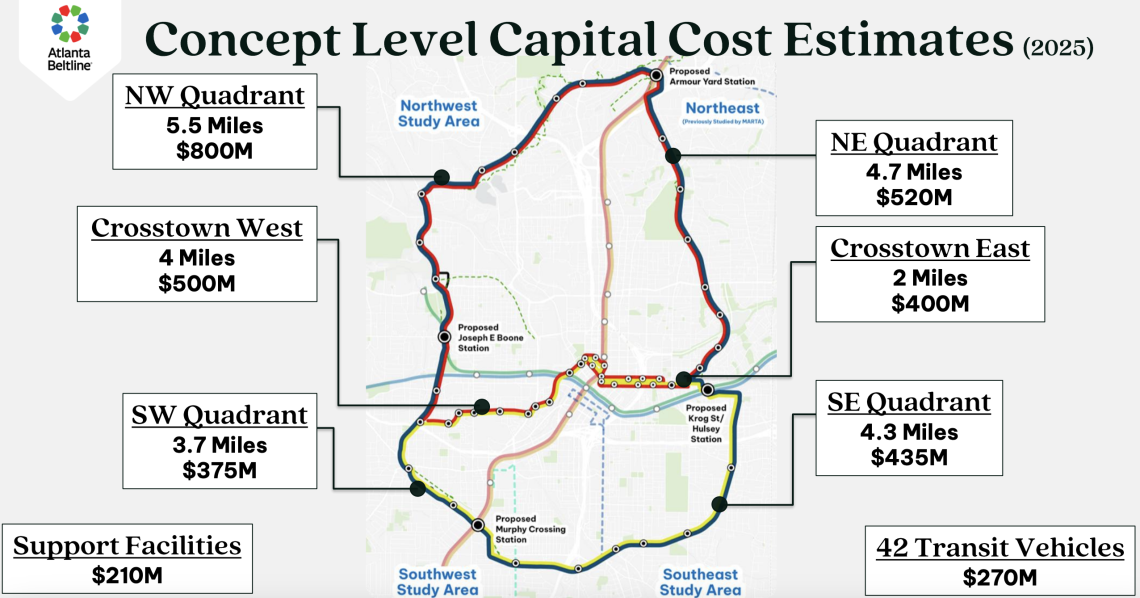 Breakdown of segment costs totaling $3.5 billion, excluding costs of installing train stops. Atlanta Beltline Inc.
Ultimately, these wealthy opponents of the Beltline rail system can’t truly understand the need for reliable, affordable transit because they are so far removed from it. It’s not their fault; it’s just the reality we live in.
They don’t need to get to a kitchen job in a Beltline restaurant by 9 a.m. during a thunderstorm to start prep work.
They haven’t had to decide between $25 in paid parking and the $13 cost of calling a car each way to work a $12-an-hour job.
They haven’t had to struggle getting groceries home with a disability and no vehicle.
They don’t worry about how to get their children to the school that is best for them.
The whole point is to connect workplaces and schools with cheap, reliable transportation. A parent working at a Beltline business could drop their kids off at school, get to work, and pick them up for a reasonable fare.
A kid from Southwest Atlanta attending Midtown High School today, for example, has to take a train and two buses to get there and get home: three fares and two transfers, each way. The planned rail will connect more than 20 schools with neighborhoods around the city.
Every proposal by a wealthy opinion columnist to tap into our rail fund promises more traffic, less reliable service, and higher out-of-pocket costs for everyone in Atlanta who needs these rides to get to work and school.
— Casey Stokes
...
Follow us on social media:
Twitter / Facebook/and now: Instagram
• Letters to the Editor (Urbanize Atlanta)