

Editor’s note: September is drawing to a close as one of the most eventful—and possibly consequential—months in history for the concept of light-rail transit encircling the 22-mile Atlanta Beltline corridor. Weighing in on the matter today, with our latest Letter to the Editor, is Eric Goldberg.
Goldberg is a 30-year Atlantan and current Inman Park resident who’s advocated for Atlanta transit, including Beltline rail, for much of the past decade. He writes:
...
Dear Editor,
Part of Atlanta City Council’s unanimous resolution on Sept. 21 supporting 22 miles of light rail around the Beltline contains an accountability metric.
The resolution asks the Mayor’s office, Atlanta Beltline Inc., and MARTA to develop an implementation plan and timeline for the project by late January 2027.
But, it doesn’t sound like one-third of that equation, the Mayor’s office, is on board with a collaborative and honest implementation process.
Atlanta Mayor Andre Dickens told the SaportaReport in an interview last week “there’s somebody that can write ‘Beltline rail’ on the Internet, and you know, if you put those two words together you sound very smart,” Dickens said. “Until you start figuring out that we’ve got to operate this thing, we’ve got to bond it or something.”
For Dickens, the term “operate” is code for “it’s too complicated.” He used the same term in a WABE “Closer Look” interview with Rose Scott a year ago. All of this overlooks the fact that it would not be the mayor’s responsibility to operate the Beltline light rail system, just as it doesn’t operate MARTA’s heavy rail system. MARTA does that. And operating 22 miles of light rail would fall on MARTA.
Is the mayor so jaded about this city’s transportation agency he doesn’t think it’s capable of operating a light rail system that already has a transit right-of-way in place?
Major cities across the United States—Phoenix, Seattle, Portland, Charlotte, Kansas City, San Diego, Denver, and Salt Lake City to name a few—operate their light rail systems, which are integral to those cities’ overall transit plans, just fine. It’s not too complicated for those municipalities, so why does the mayor think Atlanta is less capable?
The mayor seems to be signaling that it’s the Mayor’s office and ABI, a city agency that oversees the Beltline and includes the mayor as part of its board, that will be building the blueprint for what is or isn’t in the cards for Beltline rail.
How might MARTA’s newly minted CEO Jonathan Hunt feel about the prospect of being cut out of a Beltline rail implementation strategy?
Said Dickens in the same SaportaReport interview: “Now it’s time to go down the path of actually implementing these things, and you will see… We’ve got [Beltline CEO and president] Clyde [Higgs] and his team working to produce something.”
The good news: ABI’s transit engineers and staff get it. Beltline officials presented their final recommendation for a $3.5-billion transit system early in September, recommending light rail as the preferred mode for the umpteenth time, complete with 29 stations and an estimated 4.2 million annual riders.
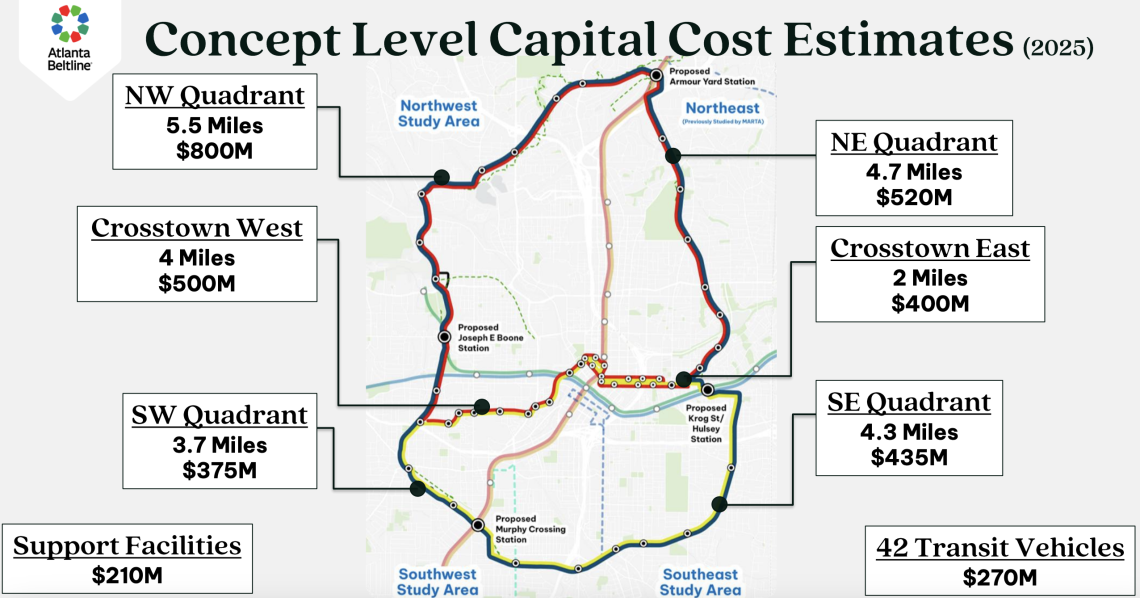 Breakdown of segment costs totaling $3.5 billion, excluding costs of installing train stops. Atlanta Beltline Inc.
The bad news: Higgs, in the aftermath of the mayor’s pulling support from the Eastside Beltline rail project in March 2025, said light rail couldn’t work on that section of the Beltline because “it’s too dense.” Hmm… Isn’t that how mass transit works? Ferrying riders to and from dense city corridors?
Higgs also spent part of the last year flirting with autonomous vehicle manufacturers about prospective deployment of minivans as the Beltline’s transit piece.
What if Mayor Dickens and his dotted-line reports put down their gloves and did what last week’s Atlanta City Council resolution is asking them to do: come together. The Mayor’s office, ABI, and MARTA, with solutions.
There’s a direct connection between the Atlanta City Council’s 14-0 vote supporting Beltline light rail and what the councilmembers’ constituents are asking of them: follow through on what they were taxed for, following the passage of the 2016 More MARTA half-penny sales tax referendum.
The 14-0 resolution means councilmembers wanted their votes on record as a “yes.” They recognize Atlantans want more transit. And specifically, their constituents want Beltline light rail.
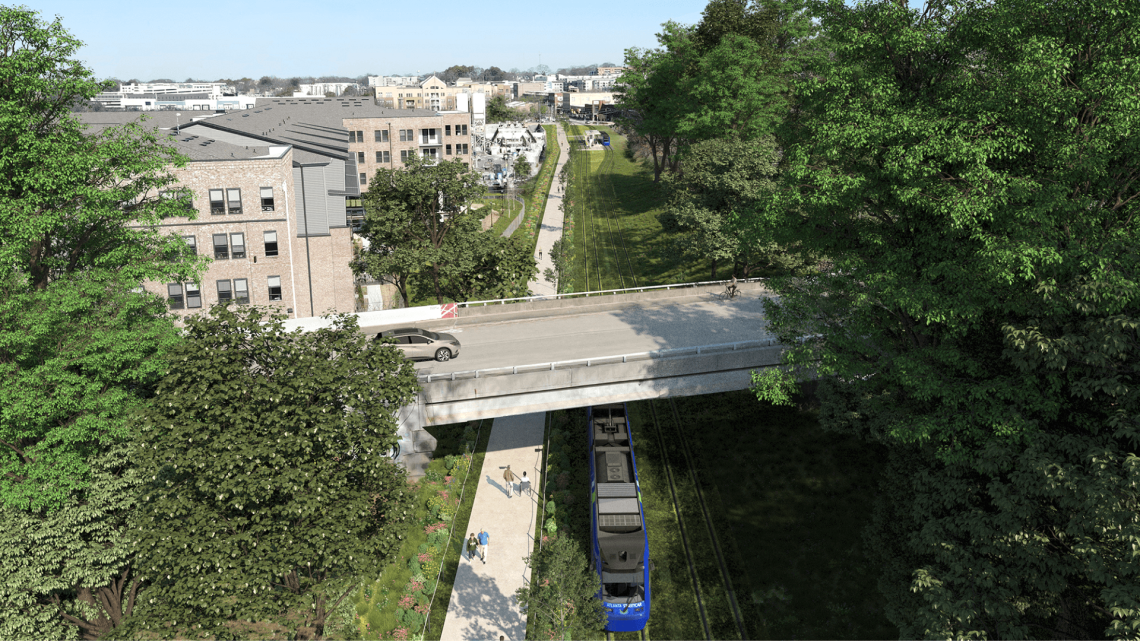 Potential look and functionality of light-rail transit under the Berne Street bridge, next to the Beltline's new Southeast Trail.Kimley-Horn; via ABI
Now it’s time to do the work. Certainly, the financing piece isn’t easy. While some funding already exists through the More MARTA sales tax—it set aside about $350 million for the project—that will cover just a fraction of the entire project.
Beltline light rail will need to be segmented; one section built at a time. It can be done. All of the financing needn’t be in place to start the project.
The transit part of the project isn’t climbing Mount Everest. Rather, it’s a matter of political will.
It’s a matter of leadership.
— Eric Goldberg
[CORRECTION: 12:59 a.m., Sept. 30: The above letter has been corrected to reflect the accurate number of Beltline rail stations planned and taxpayer funding in reserve.]
...
Follow us on social media:
Twitter / Facebook/and now: Instagram
• Shedding light on 3 recent construction failures along Atlanta Beltline (Urbanize Atlanta)