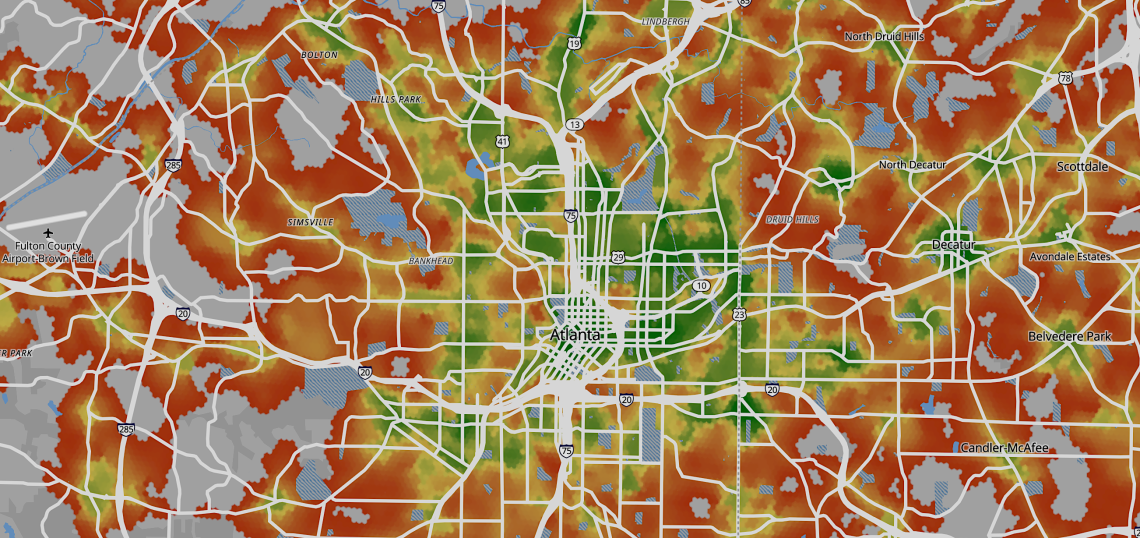
Over the past two decades, much of metro Atlanta’s growth has been defined by a push toward walkability, but as a new analysis indicates, the metro still has miles to go.
U.S. data platform BestNeighborhood has spotlighted what it calls the 10 most walkable neighborhoods in the metro as part of its national rankings that score 40 measures of daily life, covering almost a quarter-million neighborhoods total.
According to the most recent Walk Grade score, metro Atlanta as a whole scores a grade of D-. That's 12 out of 100 possible points.
Across the vast metro area, just 3 percent of people live in places defined as walkable (the national average is 9 percent), while 89 percent live in decidedly car-dependent areas, per the study reviewed by BestNeighborhood’s data science team.
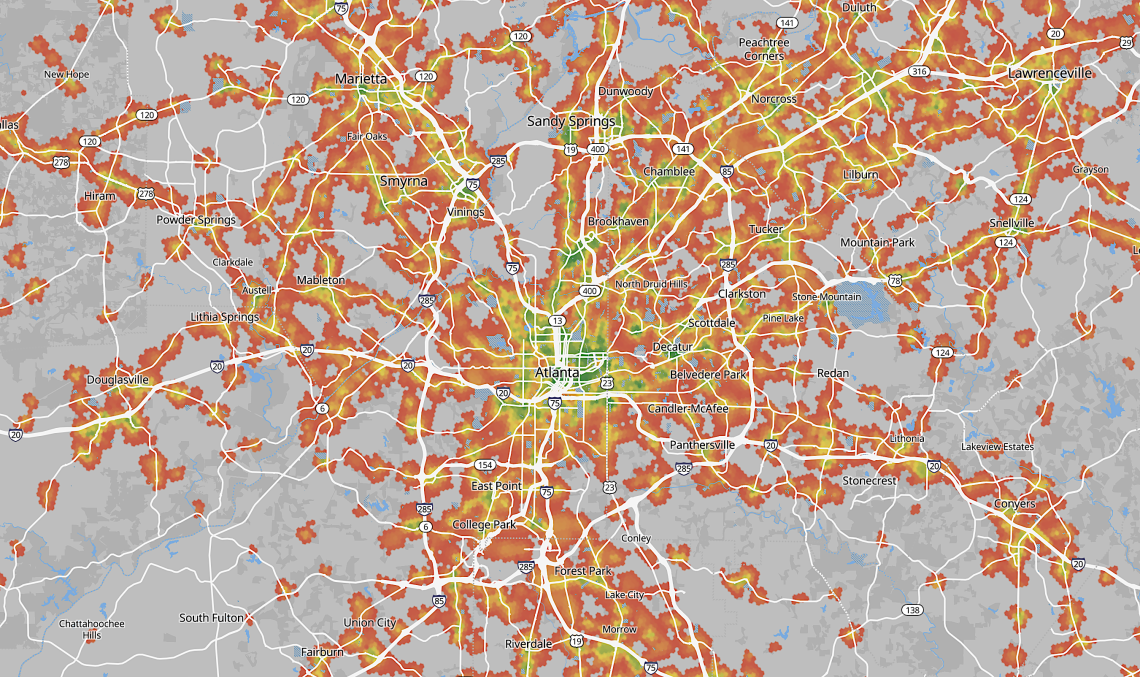 Snapshot of walkable places (green) around the City of Atlanta and many suburbs. "Sharp edges along freeways and wide arterials are real," analysts noted, "because those roads cut the walking network."BestNeighborhood/Walk Grade
From the heart of downtown to Roswell’s Canton Street, the study did find walkability bright spots across the metro, with the Top 10 graded below (0 to 100). Each “neighborhood” had to count at least 1,000 residents for consideration:
1. Five Points 91 (A+)
2. Sweet Auburn 83 (A)
3. Midtown 79 (A-), tied
4. Old Fourth Ward 79 (A-), tied
5. Inman Park 77 (A-)
6. Poncey-Highland 75 (A-)
7. Downtown Roswell, Roswell 73 (A-)
8. Home Park 72 (A-)
9. Castleberry Hill 68 (B+)
10. Cabbagetown 64 (B)
Walk Grade aims to follow actual walking routes to everyday needs—from parks and schools to pharmacies and grocery stores—and takes into account both “pleasant” and “stressful” factors such as lack of shade, traffic noise, and wide roads that encourage fast vehicle speeds.
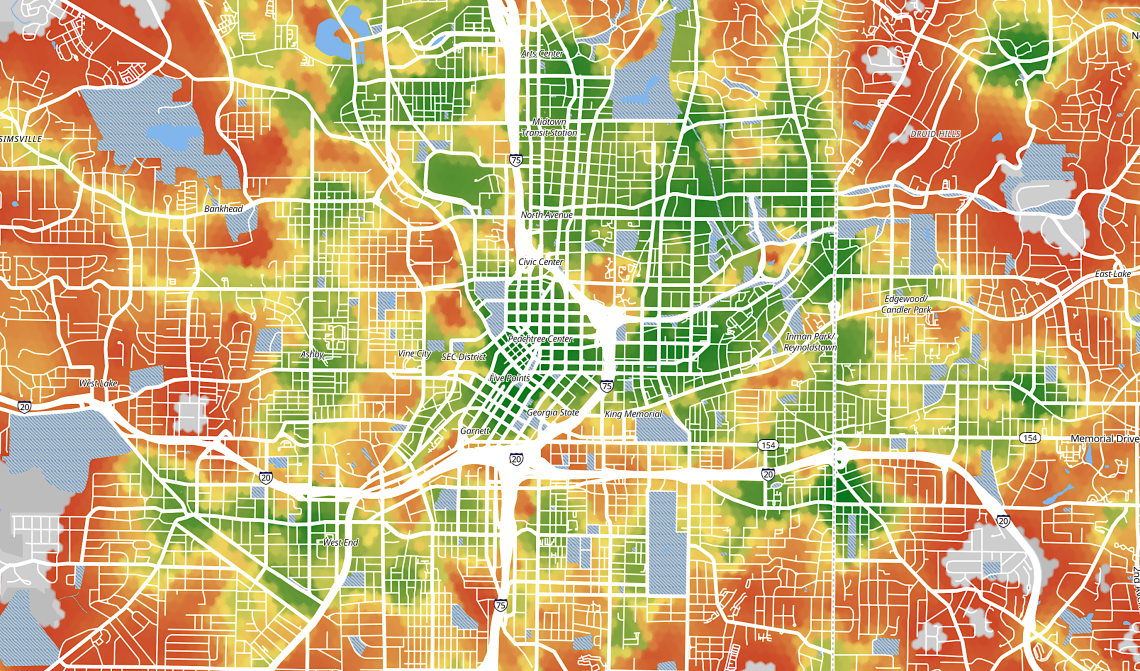 Closer look at intown Atlanta neighborhoods, where greener blocks are more walkable and red ones car-dependent. Grey areas (including parks) score near zero and were left unshaded, per Walk Grade analysts. BestNeighborhood/Walk Grade
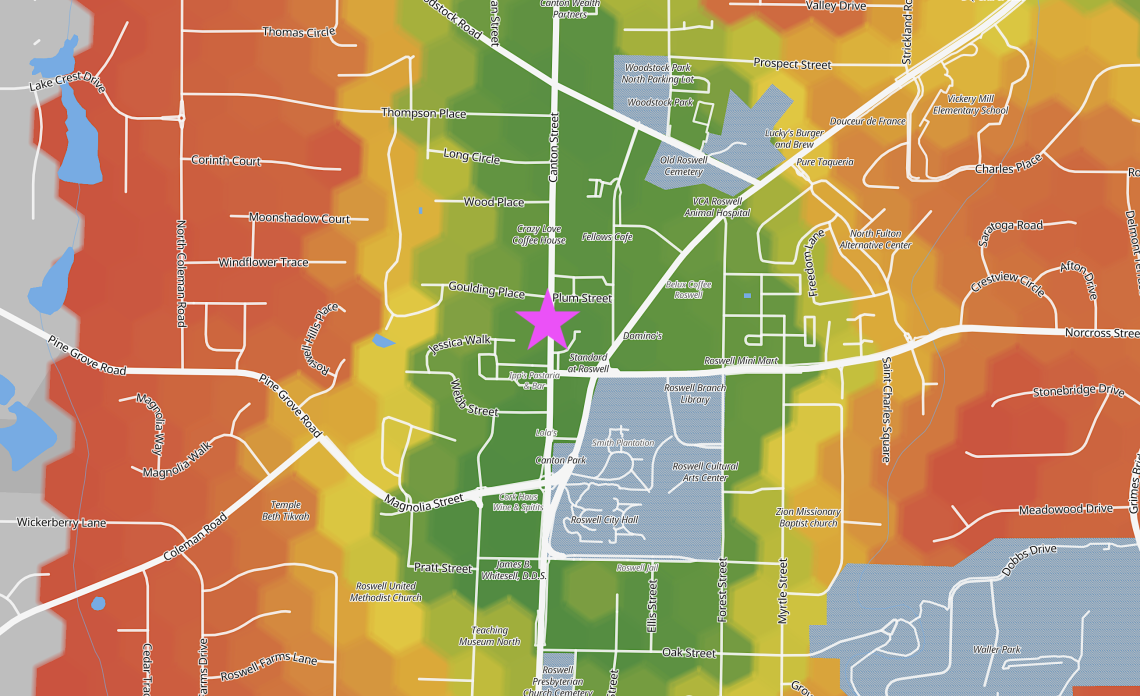 Walkability breakdown around downtown Roswell's Canton Street (starred). The north OTP city landed at No. 7 on the most walkable neighborhoods list. BestNeighborhood/Walk Grade
On the bright side (not literally), the study found that roughly 25 percent of metro Atlanta’s walking routes include tree cover—well above the 13 percent that’s typical with most U.S. metro areas.
Conversely, per the analysis, “loud, fast arterials” make up about 2.6 percent of metro Atlanta’s main roadways, above most U.S. metro areas, per BestNeighborhood.
…
Intown bikeability
BestNeighborhood also examined Atlanta’s bikeability rating; while improving, especially in a multitude of neighborhoods near the Beltline, the Bike Grade metro-wide still smacks at a low 22.
The Bike Grade, as illustrated below, points out areas where bike transportation could replace vehicles. It considers protected bike lanes, links to transit, and the amount of calm and low-traffic streets. It also uses elevation data to calculate hills—always a challenge around Atlanta.
Here’s a snapshot of ITP’s Bike Grade:
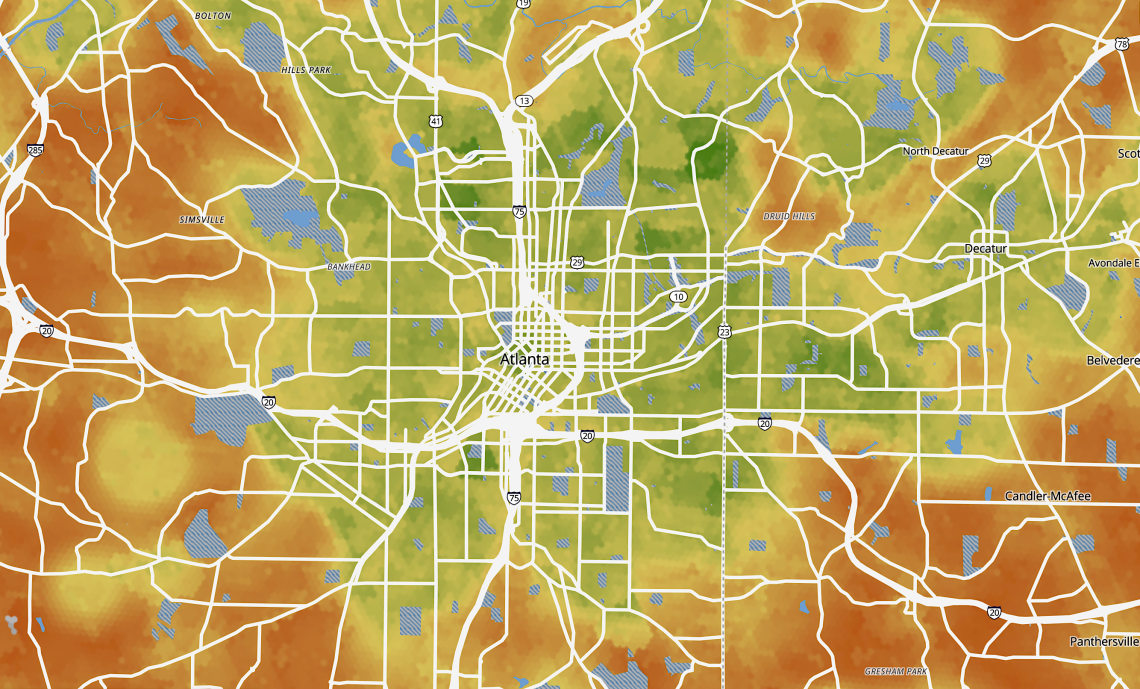 Green represents "bikeable," while red is "high-stress." BestNeighborhood/Bike Grade
...
Follow us on social media:
Twitter / Facebook/and now: Instagram
- Reader poll: What's your take on Atlanta's $9B express toll-lanes plan? (Urbanize Atlanta)