Noticeably better biking infrastructure around Atlanta and other places in the Peach State is starting to pay off, though there’s still room for improvement, according to a longstanding national advocacy group.
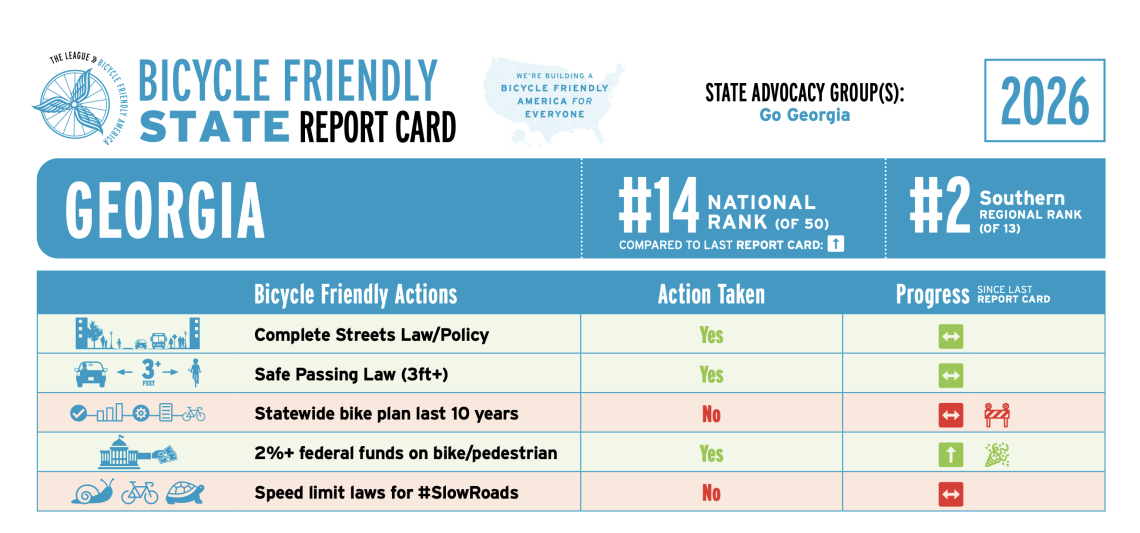
Georgia climbed an impressive nine places in the League of American Bicyclists’ new 2026 Bicycle Friendly States rankings, boosted by stronger planning, advocacy, and funding efforts—alongside infrastructure that now ranks among America’s best.
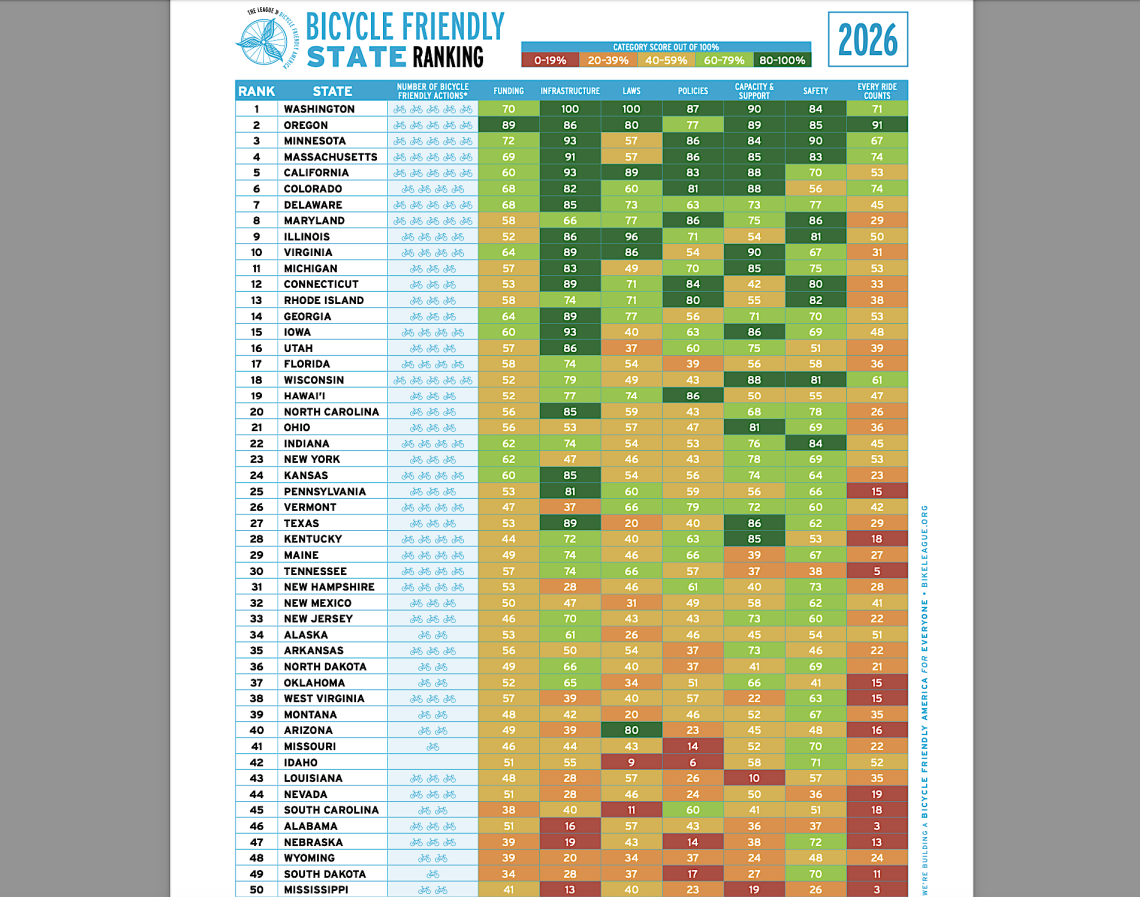
According to analysts, Georgia has leapt from 23rd to 14th place since the most recent ranking in 2024. It also climbed from 4th to 2nd among Southern states, now trailing only Virginia (No. 10).
The Peach State’s No. 14 slot puts it between Rhode Island (No. 13) and Iowa.
The study credits strong performances in planning and funding, along with special stipulations related to cycling in state law, for Georgia’s gains, alongside the work of numerous local advocates and Go Georgia, a statewide active-transportation nonprofit. Increasing the use of federal funding for walking and biking improvements across the state (the Beltline’s new Southside Trail comes to mind as one example) bode well for Georgia, per the League’s report card.
Founded in 1880, the League surveys and compiles data from all 50 states every two years to create its report cards and rankings.
The list’s top five states for 2026 bike-friendliness are dotted around the country, from Washington state (No. 1), to Oregon, Minnesota, Massachusetts, and California, respectively.
 League of American Bicyclists
The bottom five, meanwhile, goes: Alabama (No. 46), Nebraska, Wyoming, South Dakota, and lastly Mississippi, respectively, per the league’s findings.
John Devine, Go Georgia’s executive director, called the state’s improvement in the 2026 rankings “dramatic” but stressed that a “present-day crisis on our roadways” persists. Georgia’s rate of cyclist fatalities—31.4 per 10,000—thuds at 42nd place nationwide, as Devine notes.
In Georgia, the state owns 14 percent of all road mileage across the state, yet 58 percent of all bicyclist fatalities occur on those state-owned roads, according to Go Georgia officials, who cited 2024 National Highway Traffic Safety Administration data.
Devine pointed to a Rural Statewide Active Transportation Plan—paid for by a $3-million grant Go Georgia won, and soon to be finalized—as a transformative bright spot on the horizon, in terms of law, investment, prioritization, and administrative policy. Funding for the plan’s urban component is already in place; combined, the formal plans will mark a first for Georgia, per Devine.
Go Georgia works directly with the Georgia Department Transportation and the Governor’s Office of Highway Safety to increase safety.
GDOT has recently increased efforts to beef up biking infrastructure on its roadways in the city, as evidenced by new protected bike lanes on 14th Street in Midtown, the (finally) restarted construction on a pedestrian-focused intersection overhaul where Edgewood meets Reynoldstown, and other projects.
Nathaniel Quinn Cicala, GDOT’s state pedestrian and bicycle engineer, said Georgia’s boosted national ranking reflects recent progress at state and local levels for accessible bike networks.
“We’re elated to see our statewide active transportation planning efforts, such as our Rural Active Transportation plan, our vulnerable road user safety initiatives, and ongoing collaboration with local governments and advocates contributed to our improved [League] score,” Cicala said in a statement.
“GDOT remains committed,” he added, “to improved bicycle safety and connectivity for all Georgians.”
Here's a look at the full rankings for 2026—and how the Peach State is stacking up:
 League of American Bicyclists
...
Follow us on social media:
Twitter / Facebook/and now: Instagram
• Alternative transportation news, discussion around ATL (Urbanize Atlanta)