

Editor’s note: Old Fourth Ward resident Ned Falk, an industrial engineer, was inspired to heavily research urban parking environments after becoming concerned with development’s impact on his growing neighborhood. He submits the following Letter to the Editor and illustrations, which have been lightly edited for clarity and length.
…
Dear Editor,
Atlanta is growing—fast.
New residents, new buildings, new energy. But if every new Atlantan arrives with a car, our streets will clog, our neighborhoods will strain, and our housing will get more expensive. Parking isn’t just about where cars sit. It’s about how cities grow.
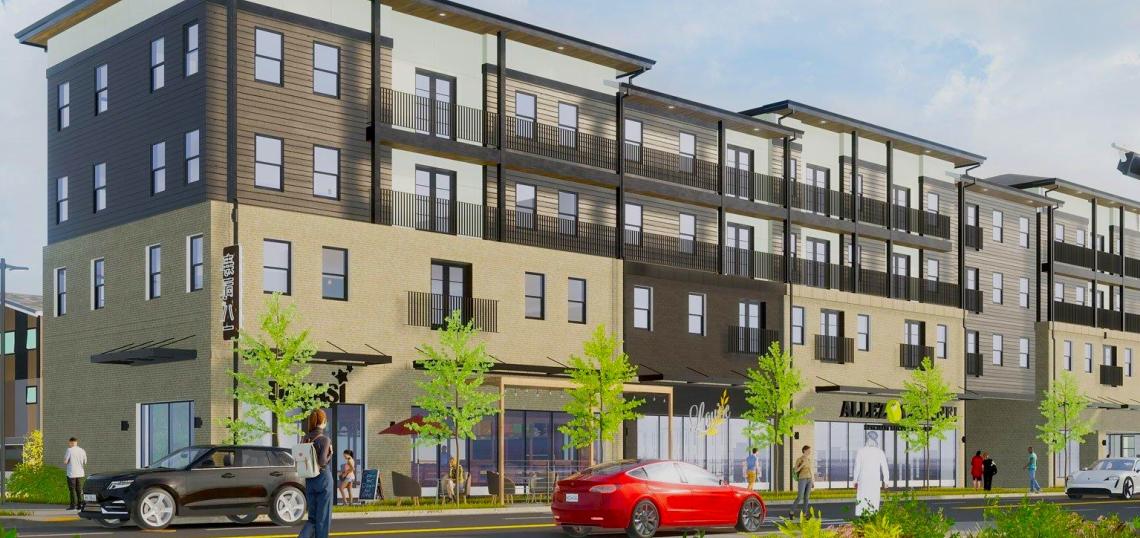
I’m not a planner by trade. I’m an industrial engineer who learned about parking policy the hard way—through Henderson Place, a new 76‑unit affordable rental and 4,000-square-foot retail building in my Martin Luther King Jr. Historic District neighborhood with only 12 off‑street parking spaces.
For more than 80 years, the surrounding historic homes have relied on curb parking. When the project moved forward, the impact on neighbors and the nearby school was overlooked. Thankfully, the city and the well-respected developers (HDDC and Mercy Housing Southeast) are now working on a mitigation plan.
Henderson Place opened my eyes to a bigger truth: Parking policy shapes Atlanta’s future far more than most people realize.
 Courtesy of Ned Falk
Why does parking matter more than you think? I'd argue that parking determines:
- How much housing we can build and what it costs
- How much traffic ends up on your street
- How a service company can access your home
- Whether neighborhoods stay walkable
- Whether a small business survives or closes
- Whether new development helps or harms existing residents.
A single structured parking space can cost $30,000 to $50,000 to build. When cities require too much parking, those costs get baked into rent and home prices. When cities allow unlimited parking, they unintentionally encourage more driving—and more congestion.
Atlanta took a major step in 2024 by eliminating off‑street parking minimums near transit and the Beltline. But minimums are only half the story. To truly reduce car dependence, cities need both “sticks” and “carrots.”
...
The sticks: policies that reduce car ownership
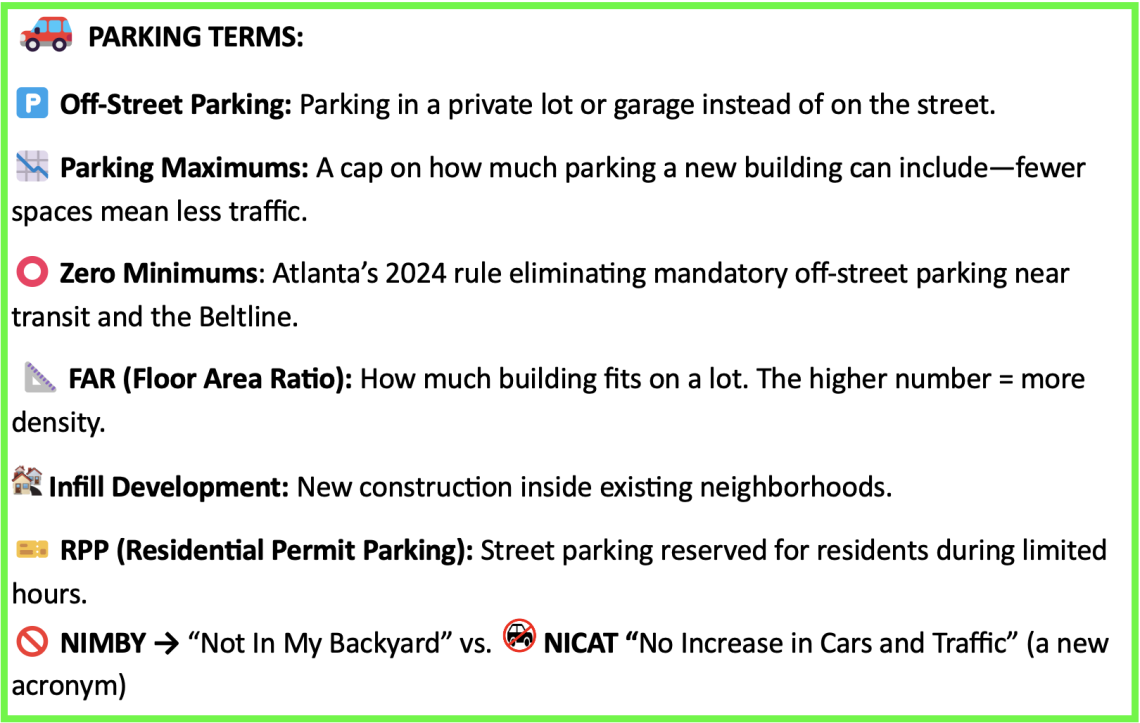
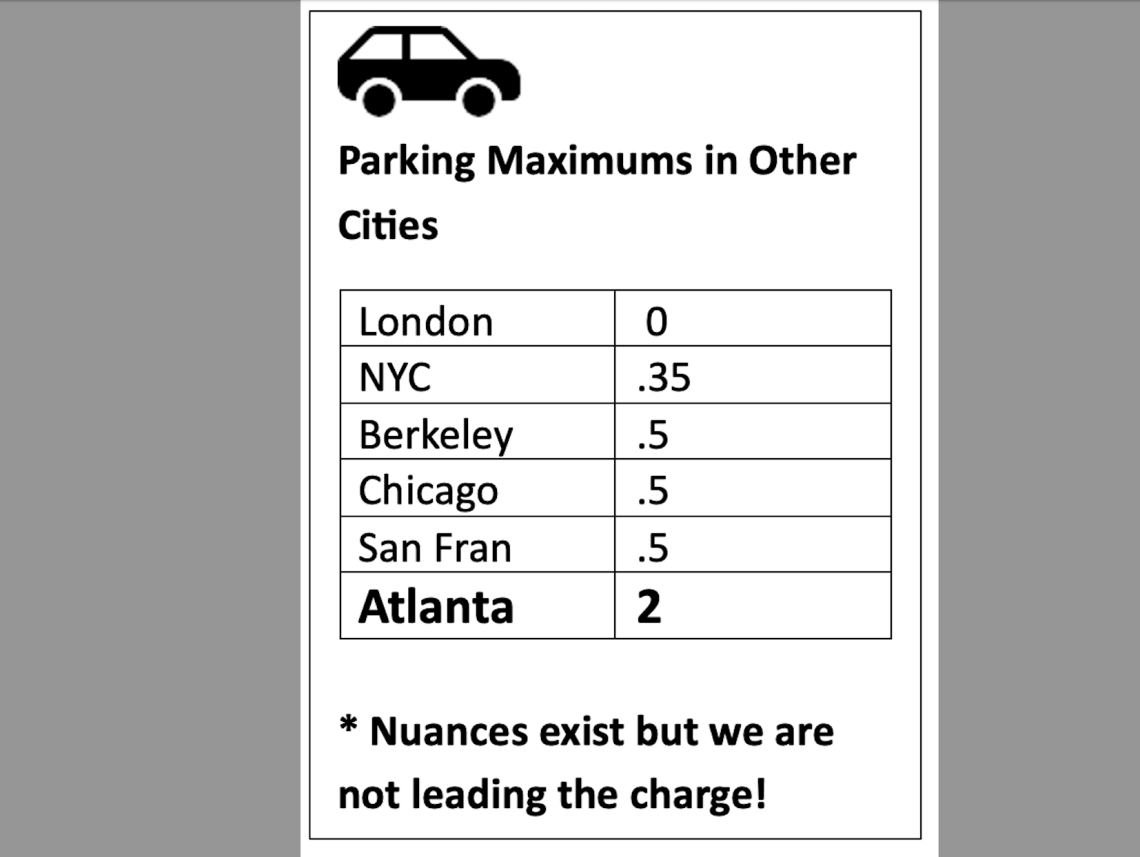
Let's talk about stricter parking maximums. Most cities now have zero parking minimums. But the cities leading the charge—Portland, Cambridge, San Francisco, London—also set maximums, capping how much parking a building can include. Atlanta’s caps are too generous, even for similar cities.
Maximums are the backbone of modern parking reform. I believe we should make excess parking more expensive.
Other cities use financial disincentives to achieve progress. For instance, in Mexico City: Build more than 1.5 spaces per unit? You pay a large transit mitigation fee.
In São Paulo, parking below a threshold doesn’t count toward FAR density limits (see definition above). Parking above the threshold does, making extra parking costly.
These policies drive developers toward smarter, less car‑heavy designs.
Another idea: Unbundle parking from rent. Right now, most Atlanta renters pay for parking whether they own a car or not. California changed that; parking must be priced separately. When people see the true cost of parking, many choose not to own a car.
While we're at it, let's design parking decks for future conversion.
If the dream of fewer cars materializes, parking decks will become dead space. Although more expensive up front, progressive cities nudge developers to design new decks for future conversion into apartments.
Now let's talk about Residential Permit Parking (RPP)—and how it can be done right.
Atlanta has RPP, but the rules don’t match how other cities protect neighborhoods. Elsewhere, “traffic generators” include anything that strains residential parking—parks, churches, businesses, and new infill multifamily buildings. These new buildings (designed with zero or minimal parking) are proactively excluded from getting permits, preventing spillover.
When RPP is done poorly, you get:
- New residents’ cars flooding curb space
- Neighbors circling for parking
- NIMBY backlash from current residents revisiting density;
rather we need more density but NICAT (No Increase in Cars and Traffic)- Teachers, parents, and home‑service workers losing access
- Longtime residents displaced from their own streets
- Overnight cars on the curb, blocking small business use.
Smart cameras (with privacy controls) can help manage curb space, enforce rules, and adjust pricing and availability and time limits. Think, during festivals or school drop‑off hours.
...
The carrots: incentives that make car‑free living possible
Rules alone won’t get Atlanta to a less car‑dependent future. Builders won’t build car‑free housing, and banks won’t finance it, unless they see proof it works.
Affordable housing is the easiest place to start.
 Courtesy of Ned Falk
Affordable housing already receives public funding and density bonuses. Parking eats into the number of units that can be built. Cities like Los Angeles, Portland, Cambridge, Berkeley, and San Francisco already build affordable housing with zero private parking.
Pairing car‑free buildings with strong RPP protections prevents spillover and encourages car‑free residents to move into new units. Meanwhile, Transportation Demand Management (TDM) incentives could include:
- Free or discounted MARTA passes
- Negotiated e‑bike discounts or free bikes
- Zipcar, Uber, and Lyft partnerships (see New York City's program )
- Turo discounts
* (Turo is a car rental where you rent your personal car)- Neighbors with cars helping those without them
- Future autonomous‑vehicle rental incentives for affordable housing residents.
But when it comes to market‑rate housing—well, that's the harder nut to crack
No market‑rate building in Atlanta has ever been built without private parking (or without tapping into existing, underused parking like Lilli Midtown), even though it is allowed. Lenders and developers fear units won’t sell or rent.
To break the cycle, we need to have a few working examples. To get that we need super incentives, such as:
- Loan guarantees from Invest Atlanta
- Interest‑rate buy‑downs
- Density bonuses
A related, crazy idea: Tesla succeeded with a super car then moved down-market. What about a Cyber Cab/ Waymo/Uber building for the ultra-rich, with a 99.9 percent instant availability guarantee. When you walk out of the elevator, your “chauffeur” is waiting—or better, your e-bike is!
Algorithms would ensure the response time of zero while allowing extra driverless cars for general use. As you move down to the middle class, the response time is lower. Or you could pay more for a higher guaranteed response time, and less for shared options.
The bottom line is this: Atlanta can lead if we choose to.
Parking isn’t just about cars. It’s about affordability, walkability, neighborhood stability, and the future of Atlanta’s growth.
We’ve already taken important steps. But to truly reduce car dependency—and reduce traffic, housing costs, and neighborhood conflict—we need to adopt the proven tools other cities already use.
For me, I am still hopeful the city and our fine nonprofits will make Henderson Place the turning point for our first car-free building.
— Ned Falk
[Note: In his letter submission, Falk relayed that his writing was tweaked using an AI program.]
...
Follow us on social media:
Twitter / Facebook/and now: Instagram
• Letters to the Editor (Urbanize Atlanta)