


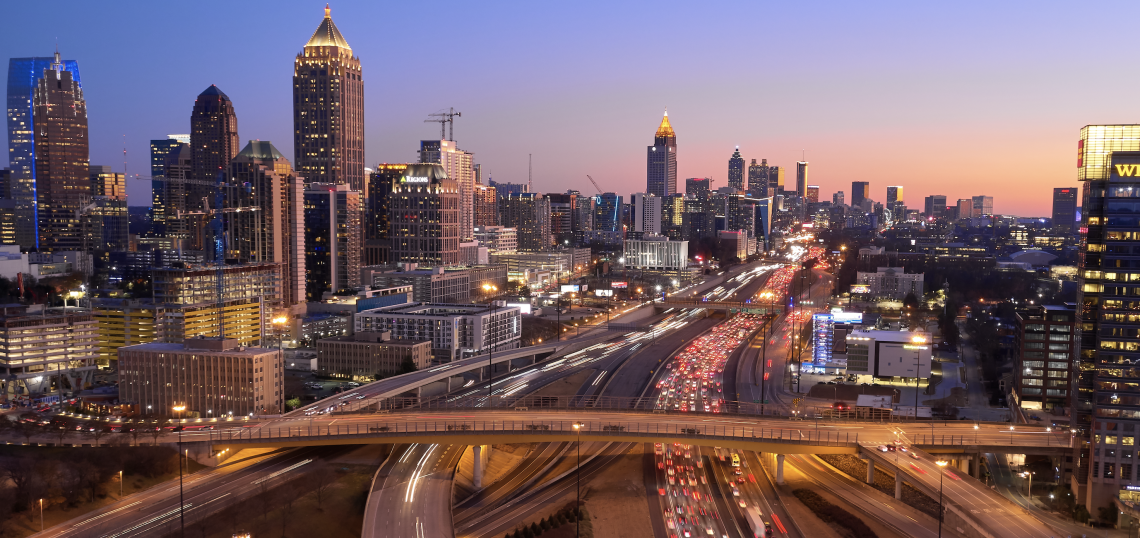
If you’re a car commuter who’s fed up with metro Atlanta traffic jams (a category that should exclude no car commuters here), rest assured in knowing it could be significantly worse, according to a new national analysis.
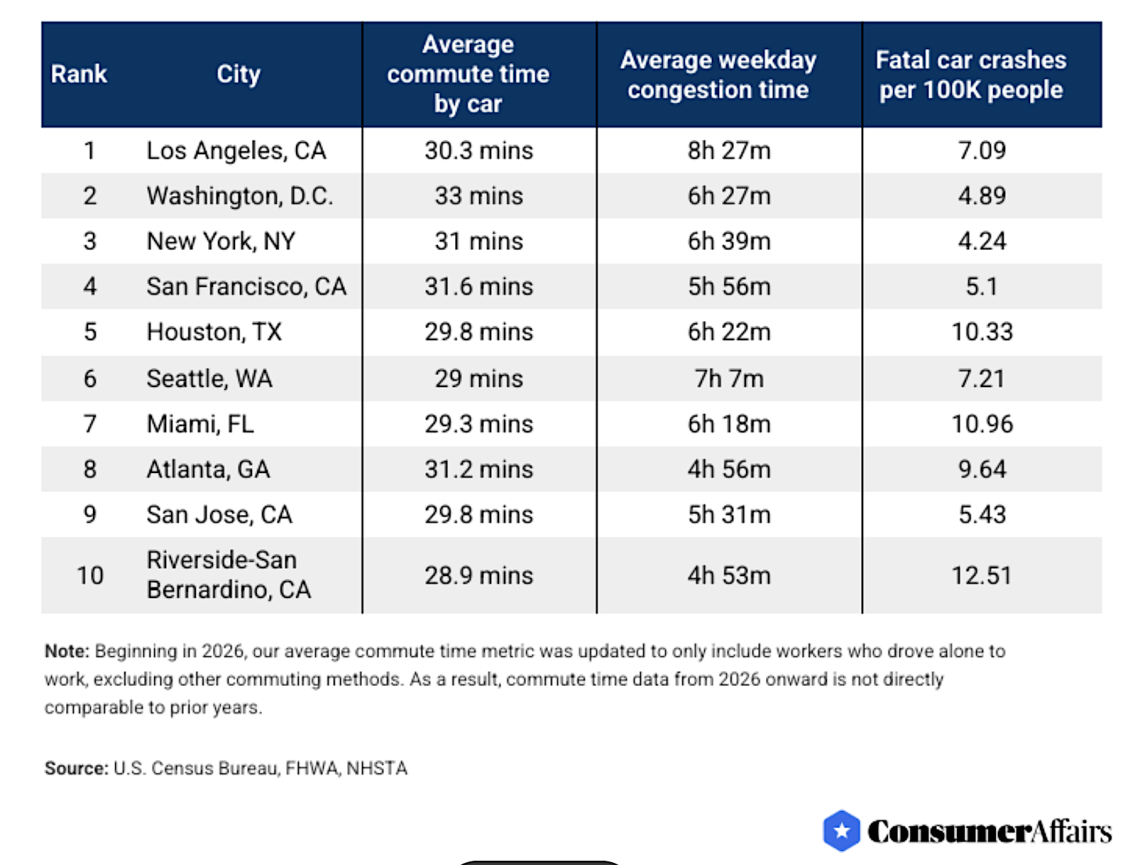
ConsumerAffairs, a consumer news and advocacy organization, has ranked metro Atlanta at No. 8 on its list of the worst U.S. cities for traffic right now.
That’s right between Miami (No. 7) and metro San Jose, respectively, which is home to nearly 2 million residents south of San Francisco.
The ConsumerAffairs Research Team analyzed the 50 most populous U.S. metropolitan areas for average commute times, daily hours of congestion, and fatal car crash rates. Among its Sun Belt brethren, only Houston (No. 5) and Miami scored worse than Atlanta.
The Atlanta-Sandy Springs-Roswell metropolitan statistical area’s relatively docile total score was 68, clocking an average commute time by car of 31.2 minutes.
 Courtesy of ConsumerAffairs
Average weekday congestion time in metro Atlanta was tabulated at 4 hours and 56 minutes—“rush hour” around here? Yeah right—while fatal car crashes per 100,000 people were 9.64, as of 2024, according to ConsumerAffairs' findings.
“Despite its reputation for gridlock, Atlanta, Georgia, is one of only two of the 10 worst metros for traffic with congestion under five hours during weekdays,” notes a summary, with the other being metro Riverside in California.
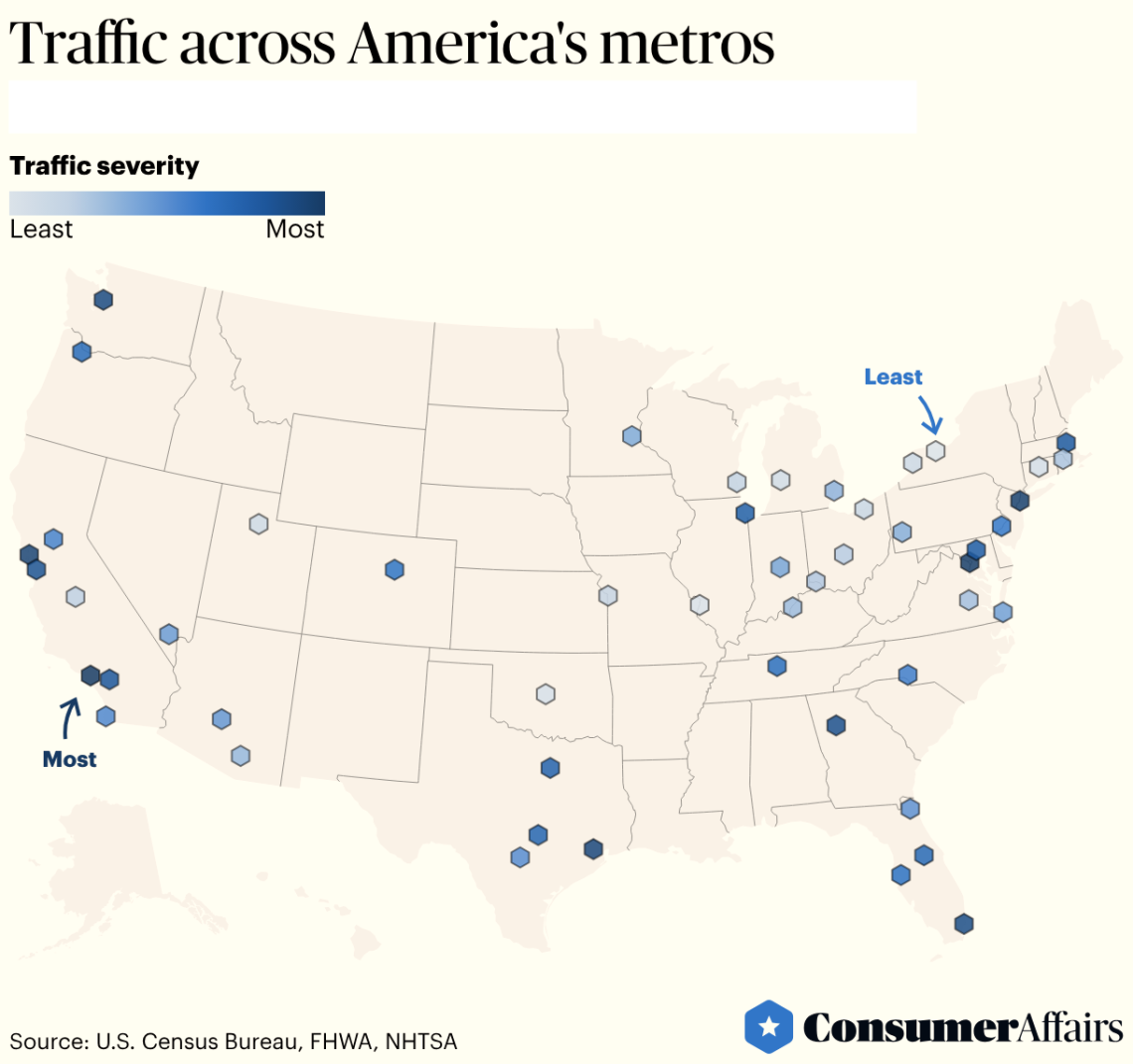
Metro Los Angeles posted the unenviable No. 1 position for worst traffic (total score: 83.37), owing largely to its whopping 8 hours and 27 minutes of daily congestion time on average.
Metro Washington, D.C. was second, hampered by the longest travel time to work on the list, an average of 33 minutes.
 Courtesy of ConsumerAffairs
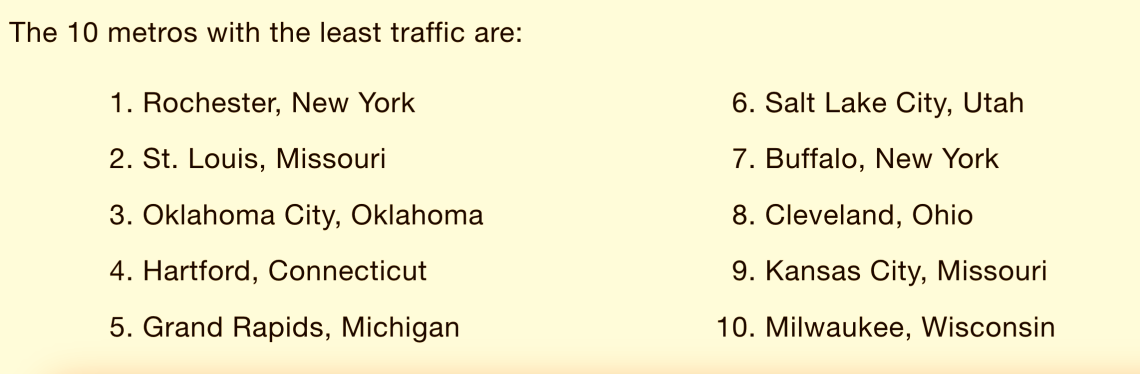
What’s the least congested metro on the list? That’d be Rochester, New York, where the average commuter needs just 21 minutes to get to and from work.
The Rust Belt dominates the low-traffic end of the rankings (hello, also, to St. Louis, Grand Rapids, Buffalo, Milwaukee, and Cleveland, among others). “These cities may have been built with a physical footprint to support booming population growth and thriving industry a few generations ago,” notes a summary of the traffic analysis, “but it’s now a kind of ‘excess infrastructure’ for the current population.”
(Excess infrastructure? Sounds like a GDOT-ian concept.)
For 2026, ConsumerAffairs found that 80 percent of the Top 10 most gridlocked cities in the country are located in the South or West.
 Courtesy of ConsumerAffairs
In terms of methodology, ConsumerAffairs weighed congested hours using data from the Federal Highway Administration’s most recent Urban Congestion Report (October to December 2025) and fatal car crash data from the National Highway Traffic Safety Administration’s Fatality Analysis Reporting System (2024).
To calculate average driving time to work, the study relied on the most recent (2024) data from the U.S. Census Bureau. It analyzed commute times among workers age 16 and older who drove to a workplace outside the home, including only those who drove alone and excluding other commuting methods, per ConsumerAffairs.
...
Follow us on social media:
Twitter / Facebook/and now: Instagram
• Atlanta named best U.S. city for starting careers—for 4th straight year (Urbanize Atlanta)