


Supporters of an extensive “Forts to Ports” interstate concept released a new case study today they say illustrates its potential to uplift sections of several states, including Georgia.
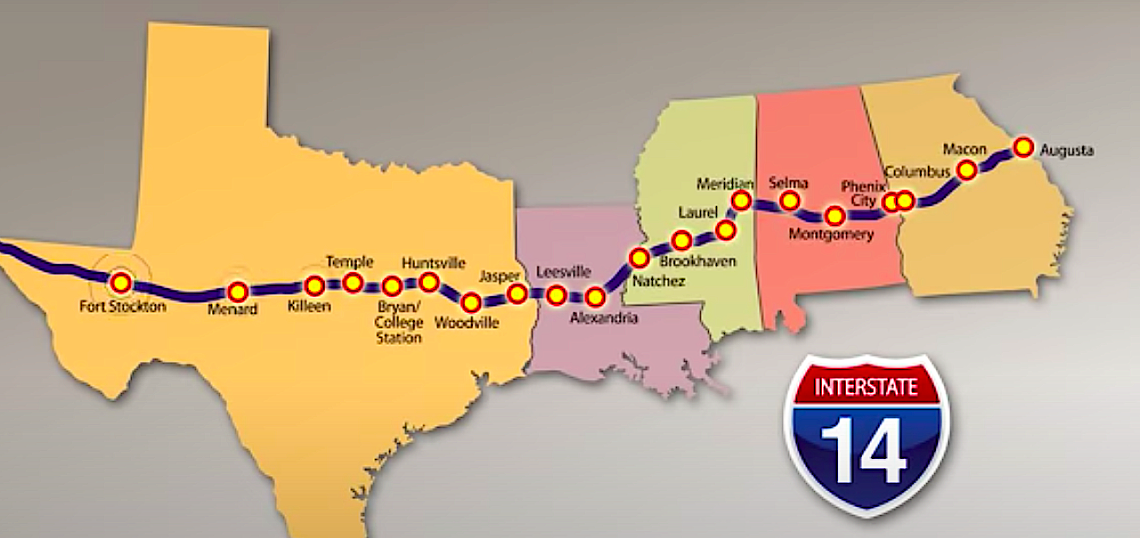
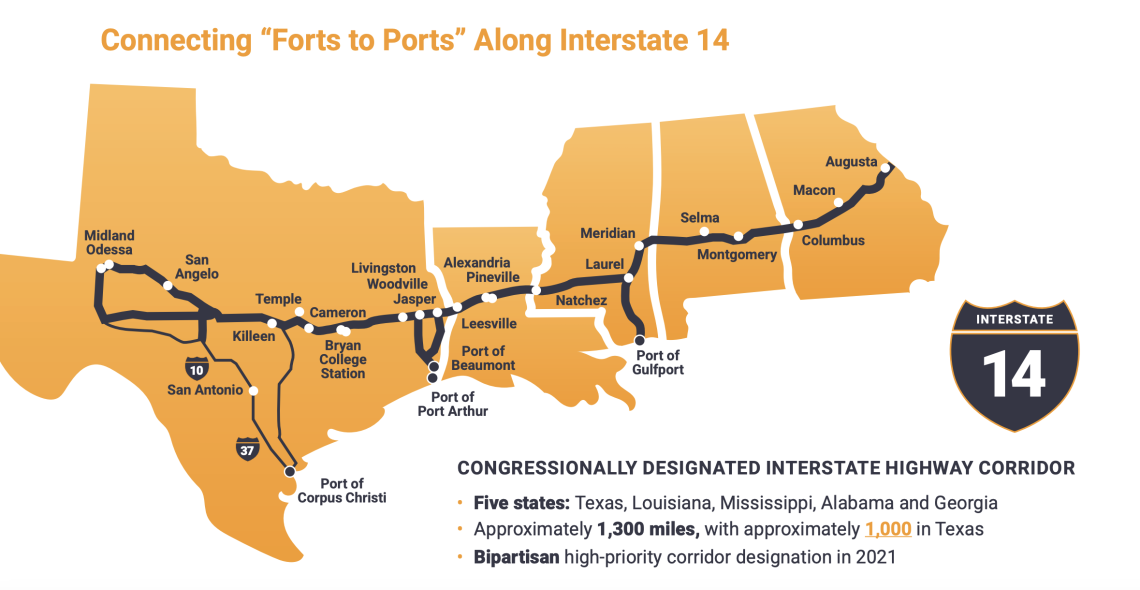
The Interstate 14 corridor calls for roughly 1,300 miles of new highway spanning five states, from western Texas, through Louisiana, Mississippi, Alabama, and Georgia, with its eastern terminus in Augusta.
Congress in 2021 designated I-14 as a high-priority corridor in a surface transportation law, a bipartisan provision advanced by Sen. Raphael Warnock (D-Ga.) and Sen. Ted Cruz (R-Texas).
In Georgia, plans for I-14 call for upgrades to the Fall Line Freeway stretching from Columbus to Augusta—roughly an hour south of metro Atlanta, at points—marking the Peach State’s first new interstate since the 1960s.
The new analysis compiled by the Transportation Construction Coalition, which bills itself as the “unified voice of America’s transportation construction industry,” suggests I-14 would enhance connections between businesses, military installations, and strategic ports across the five states in question.
In Georgia, TCC’s findings show the new interstate would serve major military hubs including Fort Eisenhower, Fort Moore, Marine Corps Logistics Base Albany, and Robins Air Force Base, which employs nearly 22,000 people as the state’s largest single-site industrial complex, per analysts.
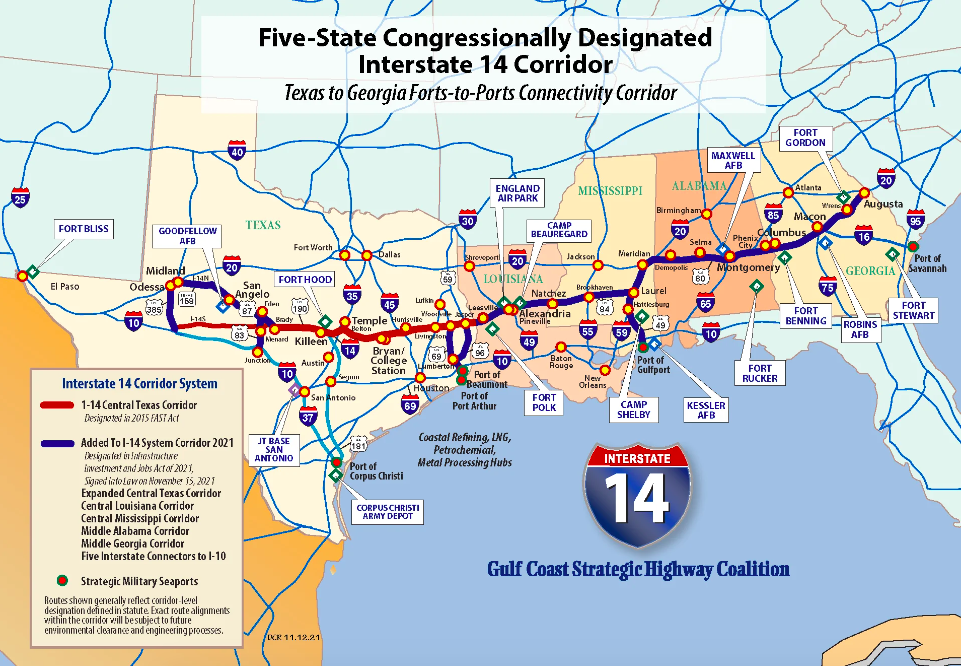 The five-state, Congressionally designated I-14 corridor. A 25-mile section in Texas expanded a highway and opened in 2017. Gulf Coast Strategic Highway Coalition
Between Columbus and Macon, the TCC study points to Talbot County, which has a 22-percent poverty rate and average commutes for residents of nearly 43 minutes. “In those communities,” notes a summary, “transportation access is not an abstract infrastructure issue—it affects whether workers can reach jobs, whether businesses can grow, and whether families can connect to greater opportunity.”
According to TCC, trucks carry about 80 percent of all freight by weight in Georgia, and logistics and freight support roughly one in every 10 jobs. More than half of the route planned for I-14 is two-lane roads today, and the corridor would “provide the structures needed for smooth, swift transport” such as adequate shoulders, while reducing congestion on more crowded east-west corridors such as I-20 today, per supporters.
To date, just 25 miles of I-14 has been completed in Texas, a stretch that opened in 2017.
 Transportation Construction Coalition
TCC stresses that I-14’s high-priority Congressional designation allows for state and federal funding to advance but does not fund or authorize construction.
“Congress must enact a long-term surface transportation reauthorization before the current law expires on September 30 [this year],” notes the summary, “to sustain federal highway investment and give states and stakeholders the certainty to plan, advance, and deliver projects along I‑14 and nationwide.”
A 2023 Letter to the Editor on these pages in support of I-14 noted its potential to siphon away heavy truck traffic and ease congestion, especially on I-20 through Atlanta.
A surge of comments on that piece indicated many Atlantans weren’t sold on the I-14 concept or interstate additions in general, with one naysayer opining: “Highway expansion is climate arson.”
...
Follow us on social media:
Twitter / Facebook/and now: Instagram
• Letter to Editor: GDOT's plan for key bridge is too boring, car-centric (Urbanize Atlanta)