


Since the days of “legendary” progressive planning commissioner Tim Keane, the City of Atlanta has been pushing for (or halting) a planned overhaul of its dated and exhaustive zoning code, which hasn’t been revised since 1982, when the city was still hemorrhaging residents to suburbanization.
City leadership recently hit pause on the latest years-long push to overhaul Atlanta’s zoning, ATL Zoning 2.0, which would essentially serve as a blueprint for future growth, functionality (including transit adaptability), and social implications.
A biting, outside analysis of the proposed zoning rewrite that’s recently become available illustrates why Atlanta leaders have hit the brakes, for now.
Completed in June, the city-commissioned evaluation of ATL Zoning 2.0 was compiled by Sara C. Bronin, an attorney, architect, author, tenured professor at The George Washington University Law School, and founder of National Zoning Atlas, a breakdown of zoning across more than 33,000 U.S. jurisdictions.
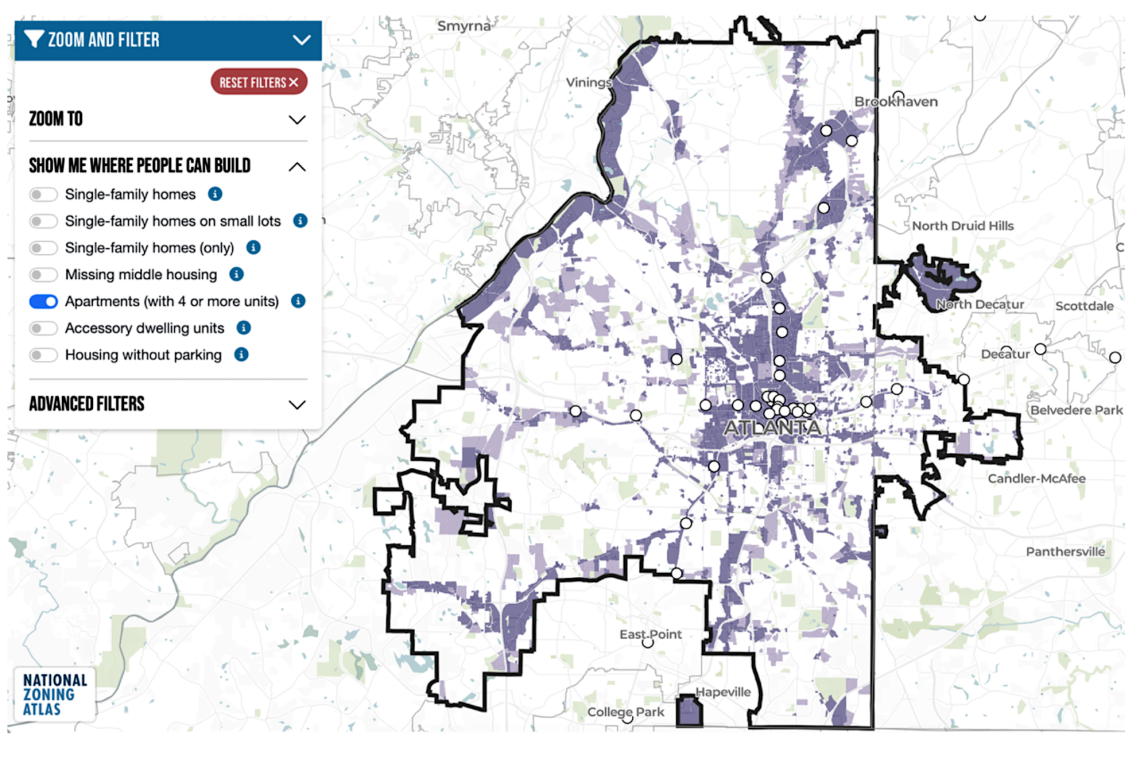 In purple, the small portion of land where four or more family homes, aka apartments, are allowed by right in Atlanta, per Bronin. National Zoning Atlas/Sara C. Bronin
Bronin spends the majority of 41 pages blasting Atlanta’s current zoning as “measurably problematic” by many metrics and the “confusing” draft rewrite as insufficient—if not possibly worse than what’s in place now.
She does extend kudos to the draft’s proposed elimination of most residential parking minimums across Atlanta, its “clear graphics,” and tweaks for Accessory Dwelling Unit, or ADU, requirements that could help unlock more affordable housing.
Below are some key excerpts and cherry-picked stats that help paint the zoning picture of Atlanta today—and the city’s makeup as a whole—per Bronin’s findings:
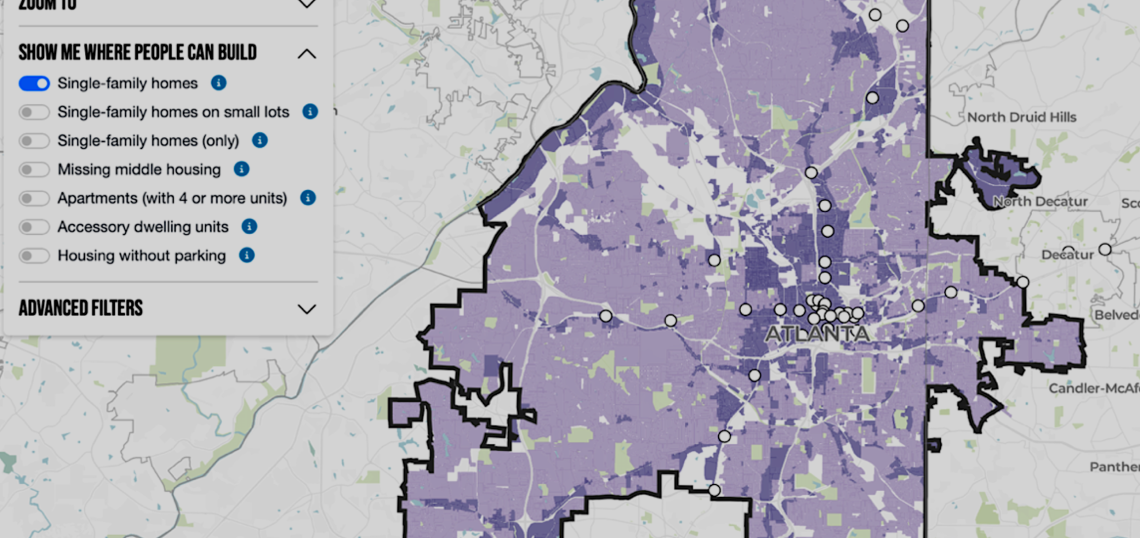
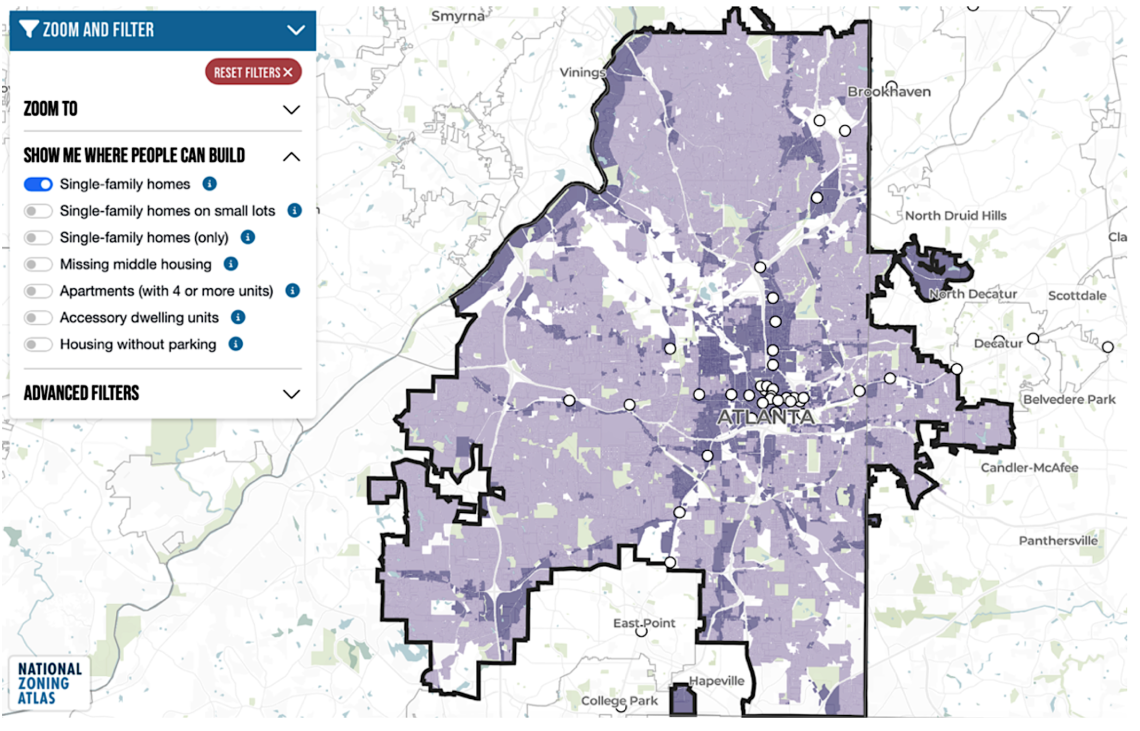
- Some 95 percent of all residentially zoned land in Atlanta allows for single-family housing by right; meanwhile, apartments—or four of more family homes together—are barred from most of the city, including in high-income northern neighborhoods where they’re needed, per Bronin.
- Overall, Bronin argues, the draft code “fails to make any meaningful changes to the zoning map, locking single-family neighborhoods and ADU permissions into today’s exclusionary patterns.”
Axing parking minimums, as the draft code proposes, would “significantly lower the cost of development while opening up more land to be used for housing, reducing private subsidies for car use, and reducing the amount of impervious surface in the city.”
The large amount of land in Atlanta allowing single-family housing by right—95 percent of all residentially zoned land—per Bronin's analysis. National Zoning Atlas/Sara C. Bronin
- Atlanta’s entitlement process today is anything but streamlined. Writes Bronin: "Atlanta’s current zoning code is longer and more complicated than nearly every other code in the country. One way to gauge this complexity is the number of pages of zoning text: 852. Atlanta has one of the longest codes in the National Zoning Atlas database for a city of its size. Atlanta’s code is more than three times as long as those of Chicago (269 pages) and Philadelphia (277)."
- The average number of zoning districts per jurisdiction nationally is just 17—or one-sixteenth the number of Atlanta’s. “Complexity is baked into Atlanta’s current code,” writes Bronin, “and it is no wonder that many view it as hopelessly complicated.”
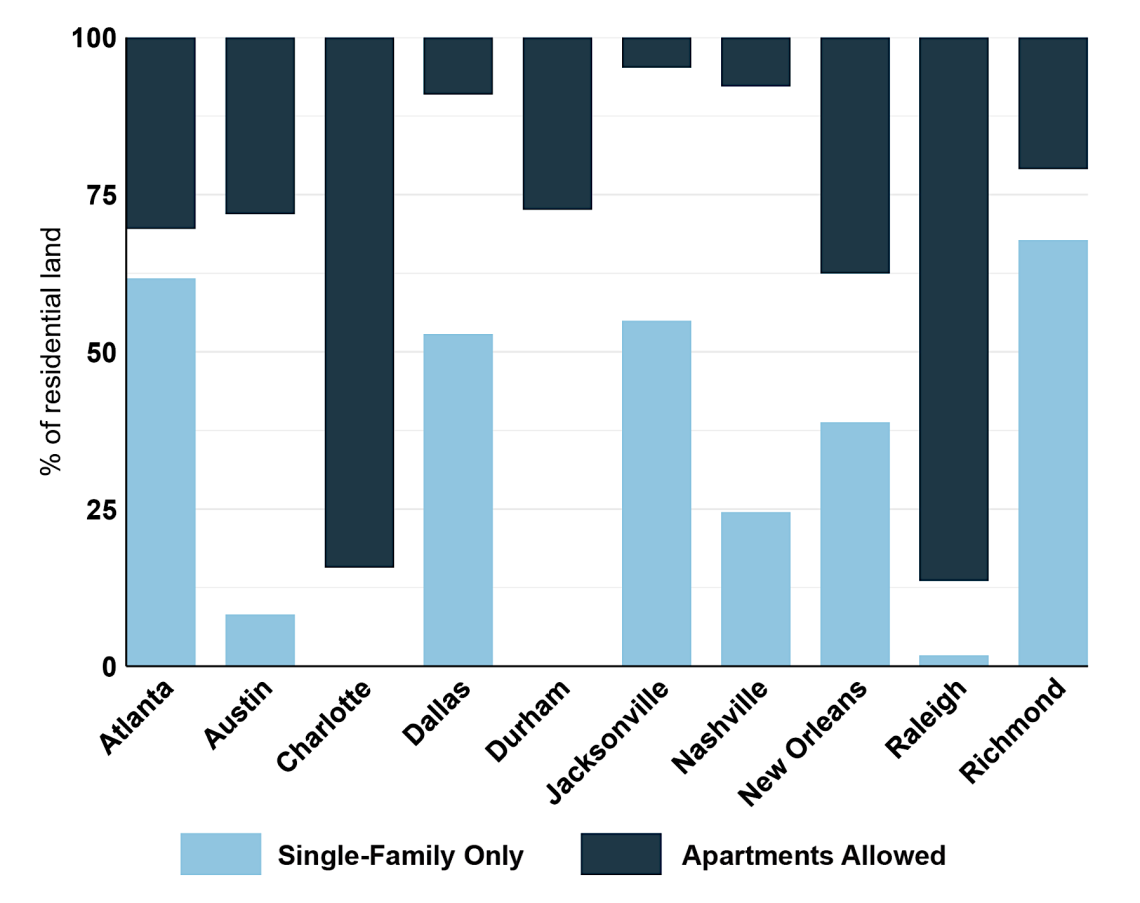
Of nine peer cities studied alongside Atlanta, from Dallas to New Orleans to Raleigh, Bronin found that Atlanta has a higher portion of its land devoted to only single-family housing than any other except Richmond. “Several cities have very little (Austin, Nashville, Raleigh) or even no land (Charlotte, Durham) limited to just single-family housing,” she wrote.
Sara C. Bronin analysis
- Atlanta also “prohibits ADUs on a higher portion of its single-family land than any city but New Orleans, and it allows ADUs on less than half of such land.”
- On a positive note, per Bronin, the draft code would bump up the maximum permitted size of ADUs from 750 to 850 square feet, allowing for both detached and attached dwellings.
- However, in both the current and draft code, ADUs are “not permitted in the wealthy, single-family-only northern neighborhoods (such as Buckhead); nor are they permitted in the southwestern neighborhoods of Adams Park or Cascade Heights. ADUs are also prohibited in many areas within the Beltline [overlay district].”
- By Bronin’s accounting, 56 percent of land in the City of Atlanta is zoned to allow only single-family homes, and no other type of housing.
- Bronin describes the rewrite’s approach to minimum lot sizes as “stubborn,” “expensive,” and “very problematic.” The draft code “fails to make any significant changes to current minimum lot-size mandates, which among other things ensure the city’s large-lot, single-family neighborhoods remain fortresses, locking newcomers out.”
- In summary, per Bronin, “Atlantans deserve a simpler, better zoning code. With the right zoning code, far more than 20,000 units of housing [a stated goal of Mayor Andre Dickens] can be created. Public land can be used for housing and complementary uses along with it. As the housing stock is refreshed and expanded, it can improve in quality. With a code focused on housing creation, unhoused people who need housing can more easily obtain it.”
So what’s next?
Atlanta City Council member Mary Norwood recently told Axios the city’s Zoning Committee will host an Oct. 15 work session and possibly others to discuss changes to the zoning rewrite. Webinars are also planned before amendments would go to the Zoning Review Board and Neighborhood Planning Units for review.
A revised draft could be back before the city council as early as the first quarter of 2027, per Norwood.
The implications of changes could be huge for the future of a growing city that’s attained its highest population in history—with much more on the horizon, per one analysis after the next. One reader recently opined in an email to Urbanize Atlanta: “It will be interesting to see what, if any, of [Bronin’s] recommendations will be implemented, as they are sure to have massive impacts on the future of Atlanta’s development.”
For a deeper dive—or to venture gloriously into the wonky weeds—we’ve uploaded Bronin’s full report for review over here.
...
Follow us on social media:
Twitter / Facebook/and now: Instagram
• ATLDOT: What transportation upgrade would most improve your life? (Urbanize Atlanta)