

The good news for transit enthusiasts: Atlanta Beltline Inc. now has the deepest, most thoroughly vetted understanding of potential light-rail transit options since the 22-mile loop idea was hatched a quarter century ago.
The less uplifting news, perhaps: Following a three and ½ year, federally funded transit study, questions still remain about a timeline for breaking ground on any component related to trolleys zipping next to Beltline trails, how that would be paid for, and if the political will required to pull it all off will be in place in coming years—or ever.
With hundreds of people looking on virtually and in person in West End on Thursday evening, Beltline transit officials detailed findings of the extensive analysis for the fourth and final “citywide conversation” regarding transit solutions.
Shaun Green, the Beltline’s principal engineer, told attendees that 49 public meetings have been held and input from 13,000 people collected since the study kicked off, “which is actually pretty remarkable.”
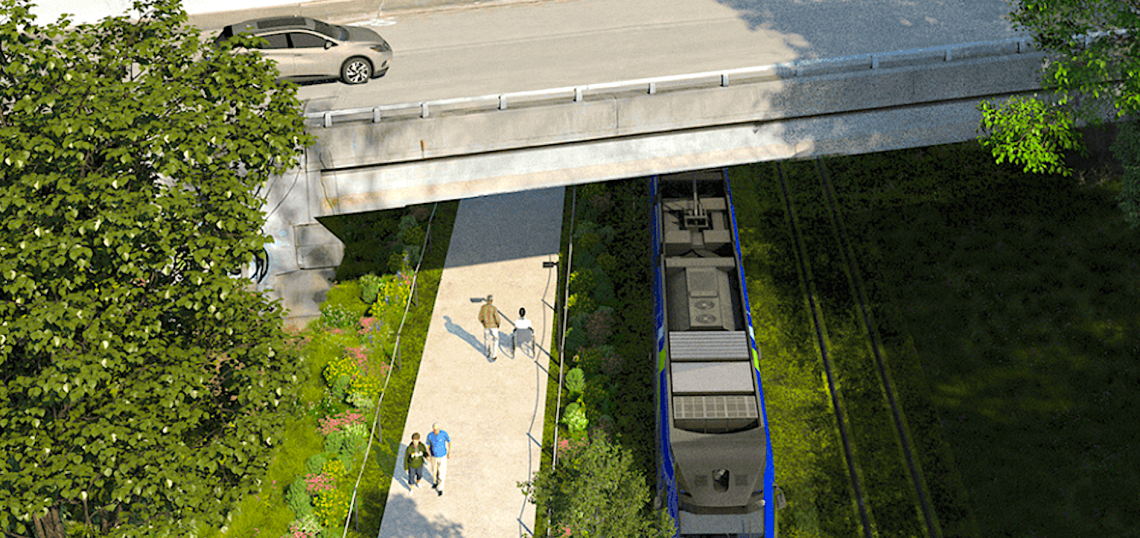
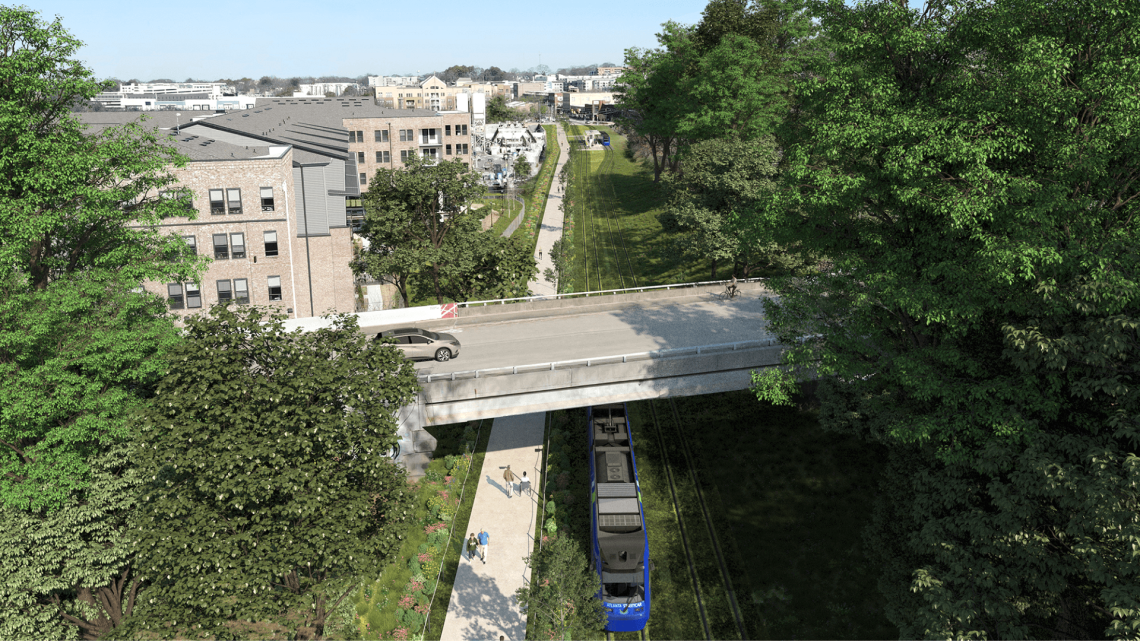 Potential look and functionality of light-rail transit under the Berne Street bridge, next to the Beltline's new Southeast Trail.Kimley-Horn; via ABI
Thursday’s meeting lacked bombshell revelations or answers to the most basic, burning question—“When will this all be built?”—but it lent hope that Beltline light-rail mobility remains firmly on the table, despite de-commitments from city officials, vocal pushback from some neighbors in recent years, and the advent of alternatives such as Beltline driverless vehicles intown.
According to Green, the transit service plan is between 10 and 20 percent designed at this point, but it represents the most “complete vision” for a permanent Beltline mobility alternative to date.
A tentative cost breakdown shows full implementation of transit would still carry a price tag of roughly $3.5 billion, including $270 million for 42 vehicles and $210 million for “support facilities.”
Green said that estimate does not include four MARTA infill stations proposed at points around the loop, noting, “We don’t have a good handle on that.” (Those stations were announced by Atlanta Mayor Andre Dickens two and ½ years ago, with few details on funding or other logistics.)
Several questions have been answered since Beltline transit heads last formally brought their findings to the public. A rundown of key points:
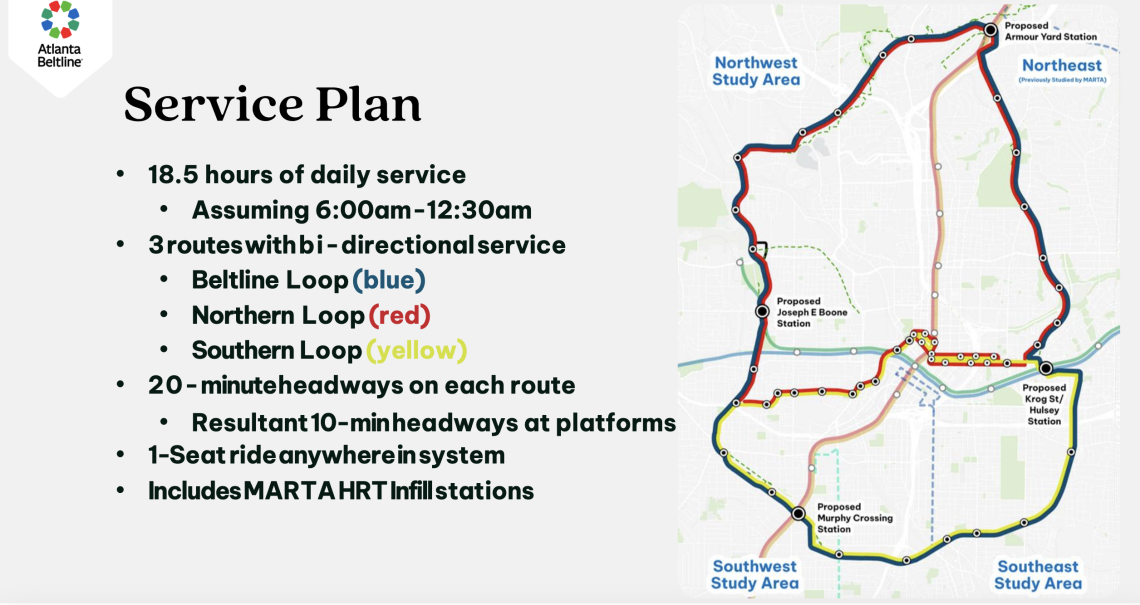
Travel times: The Beltline and engineering partners came up with a three-loop system, with light rail running both clockwise and counterclockwise along the full 22-mile oval. At the same time, two smaller loops—a north and south one—would operate the same way, providing connectivity to downtown. “That gets you a train at every platform every 10 minutes,” Green said.
Atlanta Beltline Inc.
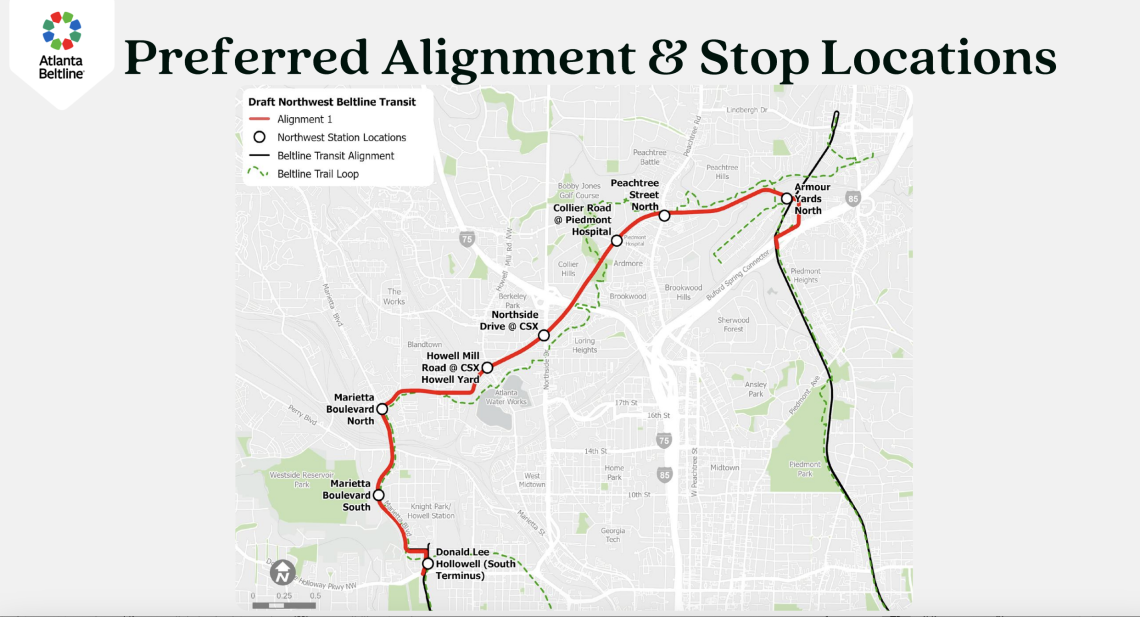
Northwest choice: From 18 different potential transit corridors, the Beltline whittled viable contenders down to three for the northwest corridor, spanning roughly from MARTA’s Bankhead station up to the Lindbergh/Uptown district. The option using CSX rail corridor was ultimately picked, as it will provide the fastest run times, direct service to the Beltline corridor’s largest employer Piedmont Hospital—“albeit from the backdoor,” per Green—and would be significantly less expensive than running trains up Peachtree Street. Still, many challenges and questions remain. “CSX has no reason to take our phone call—they generally do—but this would be a big deal for CSX,” said Green.
Breakdown of the CSX route Beltline planners are moving forward with. Atlanta Beltline Inc.
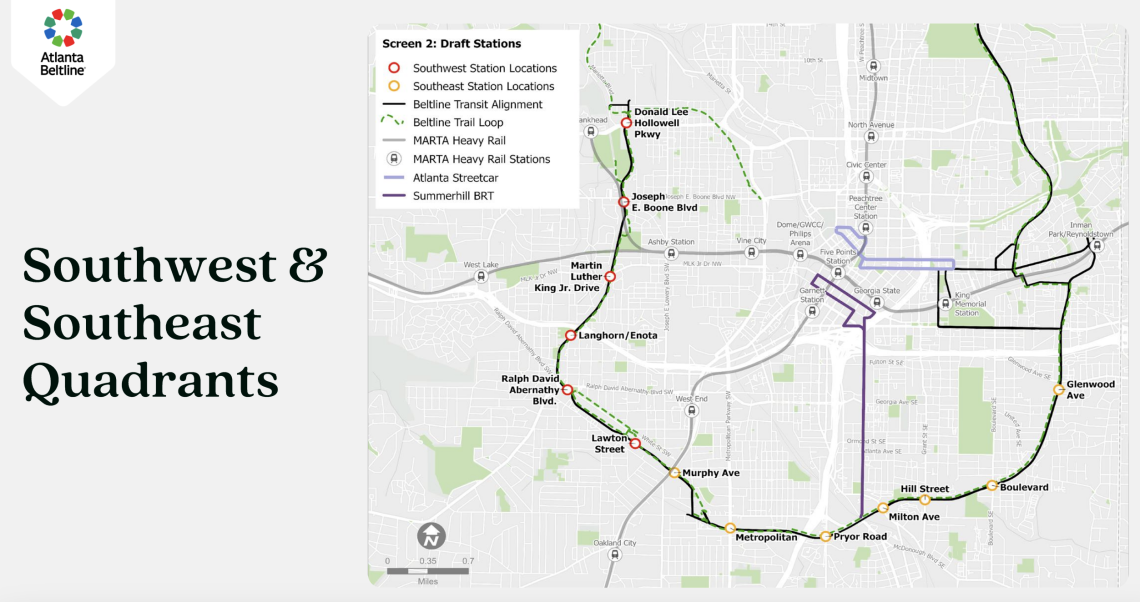
SW and SE transit stops: The outcome of proposed Trestletree Village redevelopment along the Southeast Trail could determine the placement of a potential, additional train stop between Glenwood Avenue and Boulevard, but otherwise plans are set for 13 transit stops along the Beltline’s southern smile, so to speak. Most stations would be spread ½ to ¾ miles apart. “[Beltline visionary] Ryan Gravel’s original thesis had nearly twice as many transit stops on this corridor,” noted Green, “which means travel time was twice as long as it needed to be.”
Planned location of light-rail transit stations (excluding one, potentially) on the Beltline's southern reaches. Atlanta Beltline Inc.
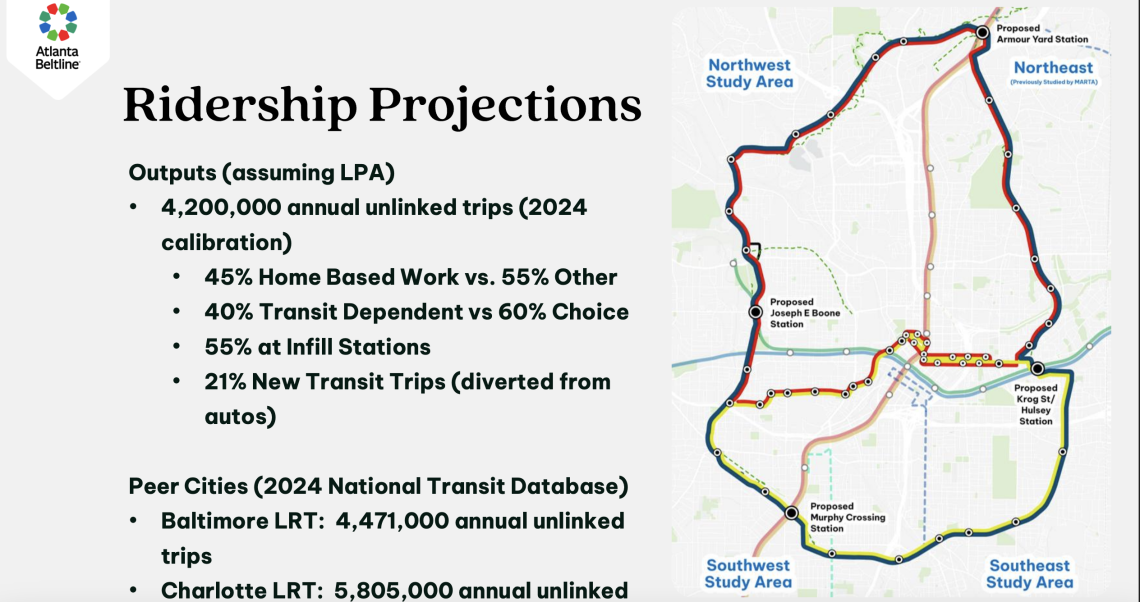
Ridership: Using 2024 data, projections indicate the light-rail system could see 4.2 million boardings per year, counting each time someone gets on a transit vehicle—but that’s “intentionally conservative,” as the Federal Transit Administration prefers, per Green. “FTA is not looking for overly optimistic [ridership] projections,” he said. “What they’re looking for is something reasonable or conservative so they don’t get hung out to dry at the next congressional hearing.” Projections indicate 40 percent of trips would be transit-dependent, “which means we’re actually providing a service to those who need it,” per Green. One in five would be new transit trips, diverting previous trips by car to transit—decongesting Atlanta’s roadways, in theory.
Atlanta Beltline Inc.
Now what?
One next step calls for analyzing the prospects and logistics of a MARTA infill station for a better understanding; the Beltline has picked the one proposed near Murphy Crossing in Southwest Atlanta, to work in conjunction with their mixed-use redevelopment plans there.
Plans call for getting that study to the level of the broader transit analysis, with a first community meeting in the works “hopefully before Thanksgiving,” said Green, who noted: “We’re pretty excited about this.”
Big picture, the transit study has produced a full locally preferred alternative for Beltline rail routes and logistics, which Green called “pretty huge,” alongside a capital cost estimate that goes deeper than simply a “dollars-per-mile situation.”
“We’ve done a lot of tightening up of what the transit program is over the last three and ½ years of this effort,” Green told attendees. “The outcome is that we know more about Beltline transit now than we ever have, which is actually pretty powerful. That gets us to a point where—when the politics align—we’ll be able to dive into next-level engineering [and] working toward implementation with our partners at MARTA and the City of Atlanta.”
Find a deeper analysis—including estimations of Beltline half-hour rail travel distances from key points like MLK Boulevard and Ponce City Market—on this page, where Beltline officials are also encouraging more public feedback.
One of the city’s most vocal rail advocates, Beltline Rail Now co-chair Matthew Rao, cheered Thursday’s turnout and sounded optimistic for the prospects of 22 miles of Beltline transit eventually becoming reality, with the plan, design talent, and early-stage funding in place, he said.
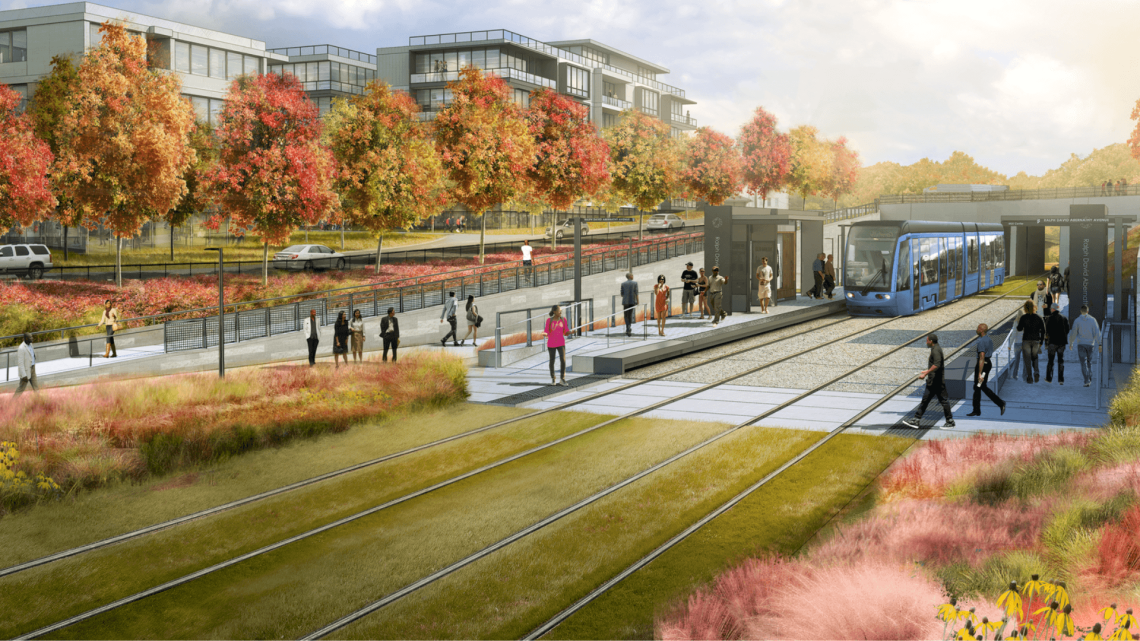 Vision for Beltline transit options on the Westside Trail at Ralph David Abernathy Boulevard. Kimley-Horn; via ABI
The next logical step, as Rao sees it, is to move toward a 30-percent design milestone on all rail segments at once for “reasons of equity, delivery time, [and] cost containment” and to “get ahead of the development and gentrification in areas where we still can do so, and to avoid encroachment into the transit corridor.”
“Strongly considering a public-private partnership as the delivery model,” Rao noted in an email to Urbanize Atlanta, “could help get most of the Beltline in service much faster and at a more minimal cost.”
Find more images and context from Thursday's presentation in the gallery above.
...
Follow us on social media:
Twitter / Facebook/and now: Instagram
• Beltline-related news, discussion (Urbanize Atlanta)