

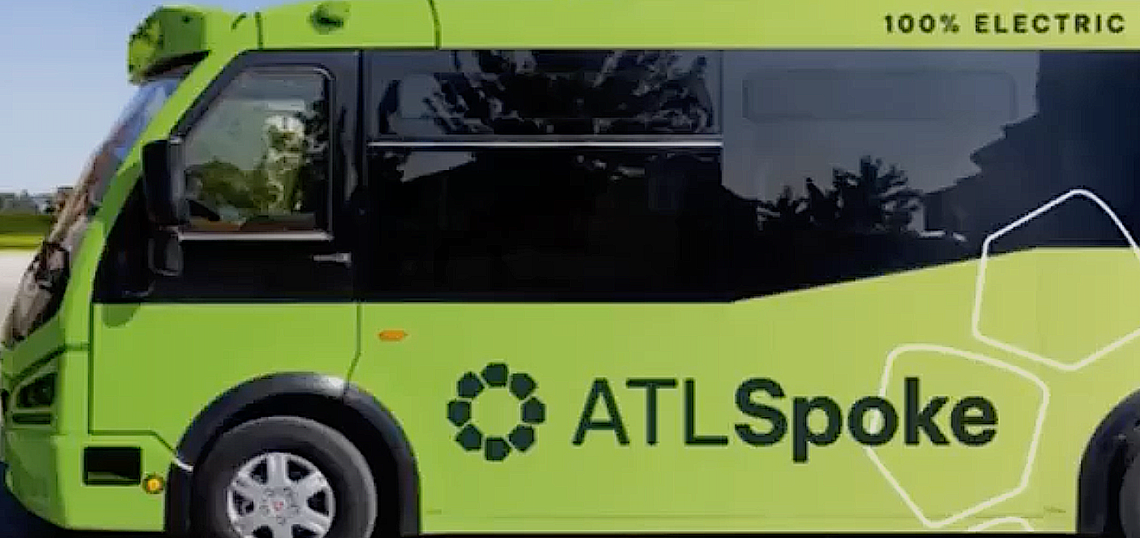
The lime-green minibuses set to start whooshing through Southwest Atlanta streets in coming months will mark Atlanta Beltline Inc.’s first stab at public transit but not the last, according to agency leaders.
Beltline brass on Thursday night shed light on the forthcoming autonomous pilot program—now coined “ATL Spoke”—and the vague outlook on more permanent, potential transit options during ABI’s first quarterly briefing of 2026.
According to Joe Iacobucci, the Beltline’s recently hired vice president of transit innovation (a new ABI position), the ATL Spoke driverless shuttles will begin service in May between MARTA’s West End station and the Beltline’s Southwest Trail at the Lee + White district. The shuttles will be free and will run seven days a week for about 10 hours, stretching from roughly noon to 10 p.m., though service hours will be extended to 16 per day during Atlanta’s month of 2026 FIFA World Cup matches.
The route will be extended north to Atlanta University Center colleges in time for fall semester, per the Beltline’s plans.
Iacobucci said ATL Spoke’s ADA-accessible, Karsan Autonomous e-JEST shuttles can fit 15 to 20 passengers and will be staffed with an attendant, who’ll be on hand to answer questions, “ensure safety, and even take over navigation if required.”
Exact operational hours and precise stop locations are still being finalized, but Iacobucci said patrons can expect a new shuttle to arrive at each stop every 12 to 15 minutes.
“So it’s going to be a very frequent service that will meet some of the frequency on [MARTA] rail,” he noted.
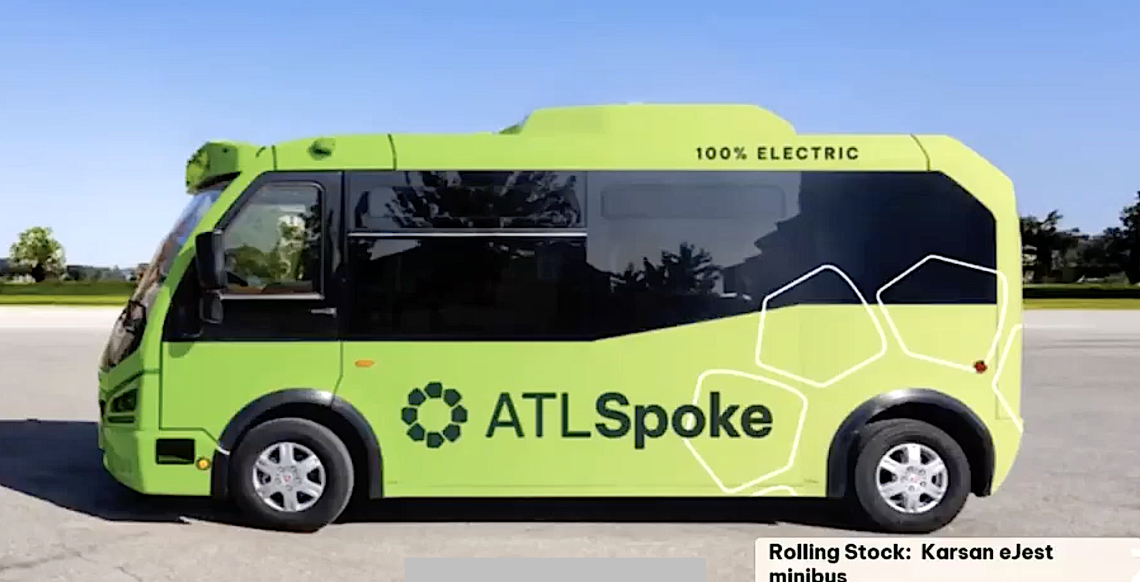 Beltline-backed driverless shuttles debuted on Southwest Atlanta streets before 2026 FIFA World Cup. Atlanta Beltline Inc.
The ATL Spoke pilot program, once it launches, will last for 12 months, as funded by a $1.75-million Atlanta-Region Transit Link Authority grant. The goal is to gather “valuable knowledge about how to deliver transit solutions across Atlanta,” per Iacobucci, who stressed during Thursday’s meeting the shuttles are meant for first-and-last mile connectivity and won’t enter the Beltline pathway corridor.
Beltline officials are coordinating with other agencies across the country that are piloting or have piloted a similar autonomous service, such as Jacksonville, “to all learn together,” said Iacobucci. A key difference is that Atlanta’s shuttles will be larger vehicles, he noted, with “higher capacity than what’s been done across the country.”
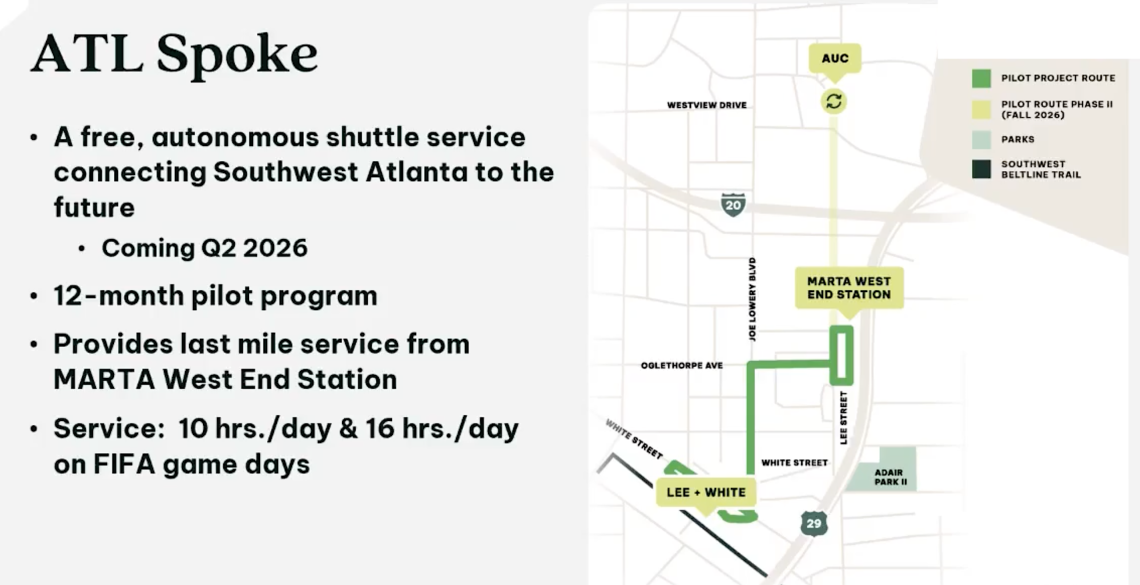 ATL Spoke routes planned southwest of downtown this year. Atlanta Beltline Inc.
The driverless shuttles could be part of a broader ecosystem of multiple transit modes around the 22-mile Beltline loop in the future—but more permanent transit solutions remain an unfunded work-in-progress, per project leaders.
Iacobucci said a three-year Beltline Transit Study, initially launched in September 2023, is on pace to be finished this summer.
The study’s intent is to determine preferred transit alignments and station locations for the full Beltline loop, setting up the project for future engineering phases and funding opportunities. According to Iacobucci, Beltline officials are “constantly in communication” with the city, Georgia Department of Transportation, and MARTA regarding transportation, including the potential viability of MARTA infill stations.
“Once we wrap that [study] up, we’ll identify next steps,” Iacobucci said.
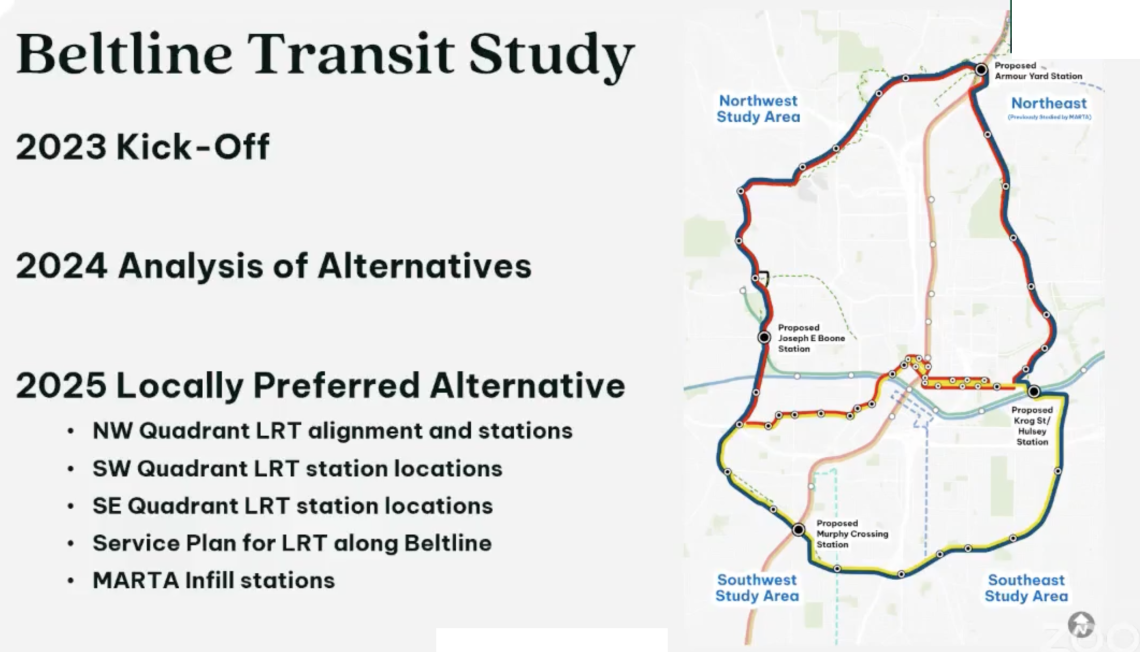 Preferred routes and proposed, unfunded MARTA infill station locations outlined in the ongoing Beltline Transit Study. Atlanta Beltline Inc.
Beltline and MARTA leadership have recently caught public flak for what transpired during monthly Program Governance Committee meetings last year involving key city officials and MARTA and Beltline leaders. That continued during a Q&A session Thursday.
The committee in May decided to pause More MARTA funding for two streetcar feasibility studies—unbeknownst to some city officials, longstanding Beltline advocates, and Streetcar Extension East naysayers, as an AJC investigation found in January. That decision effectively slammed the brakes on efforts to bring rail to the Beltline’s popular Eastside Trail.
Audience members Thursday worried aloud that the Beltline’s focus on “autonomous pods” signals a broader move away from light rail transit in the corridor, as original plans have called for—for the better part of a generation. Iacobucci’s professional experience, as pertains to a bias for autonomous options, was also called into question.
Iacobucci countered that the Beltline’s focus on autonomy, for now, is to identify places where shuttles can bring people to Beltline trails from MARTA stations, and vice versa, to generate foot traffic—and not to shuffle people around the Beltline. Across his 22-year career he’s designed all types of transit, he said, including during a dozen years with the Chicago Transit Authority, the second largest U.S. system.
“Everything from heavy rail to light rail to Bus Rapid Transit and innovative technology, I’ve spanned those types of projects,” Iacobucci said.
Clyde Higgs, Beltline president and CEO, echoed a recent ABI open letter in saying light-rail transit remains on the table, while also vouching for Iacobucci’s resume and acumen. He pointed to Program Governance Committee decisions as the reason why transit planning halted on the Eastside Trail.
“One of the things I would ask people to do is, let’s not get into a binary fight about one [transit] mode versus another,” Higgs said. “At the end of the day, I think we need them all: light rail, autonomous vehicles, bike lanes, infill stations. So that’s what we’re trying to push—kind of a full [slate] of solutions for Atlanta. It’s not one versus another. And the reason we brought [Iacobucci] on, he’s well-respected in this space.”
...
Follow us on social media:
Twitter / Facebook/and now: Instagram
• Beltline-related news, discussion (Urbanize Atlanta)