



The future of self-driving vehicle connectivity near the world’s busiest airport is a fluid situation. Officials leading the initiative reached out this week to provide clarity on where it all stands.
As relayed on these pages last week, the possibility of autonomous shuttles, buses, or pods zipping around near Hartsfield-Jackson Atlanta International Airport has been explored for years. That push echoes alternative-transportation projects underway elsewhere in the metro, such as Cumberland’s forthcoming CAM Network and the Beltline-supported Beep project in Southwest Atlanta.
Spearheading the effort is the ATL Airport Community Improvement Districts, or AACIDs, a public-private partnership of commercial property owners around the airport. Their jurisdiction covers six cities and two counties—Fulton (Airport West CID) and Clayton (Airport South CID). As with other CIDs, the district collects self-imposed additional property tax revenue from commercial property owners and reinvests that into infrastructure, transportation, and economic development projects.
“While we’re not part of the airport’s operations,” Krystal Harris, AACIDs’ program director, wrote via email to Urbanize Atlanta, “we work closely with the airport and regional partners to support the surrounding ecosystem, making it easier for people and businesses to connect to and navigate around the world’s busiest airport.”
Enter: Glydways, a California-based self-driving vehicle developer.
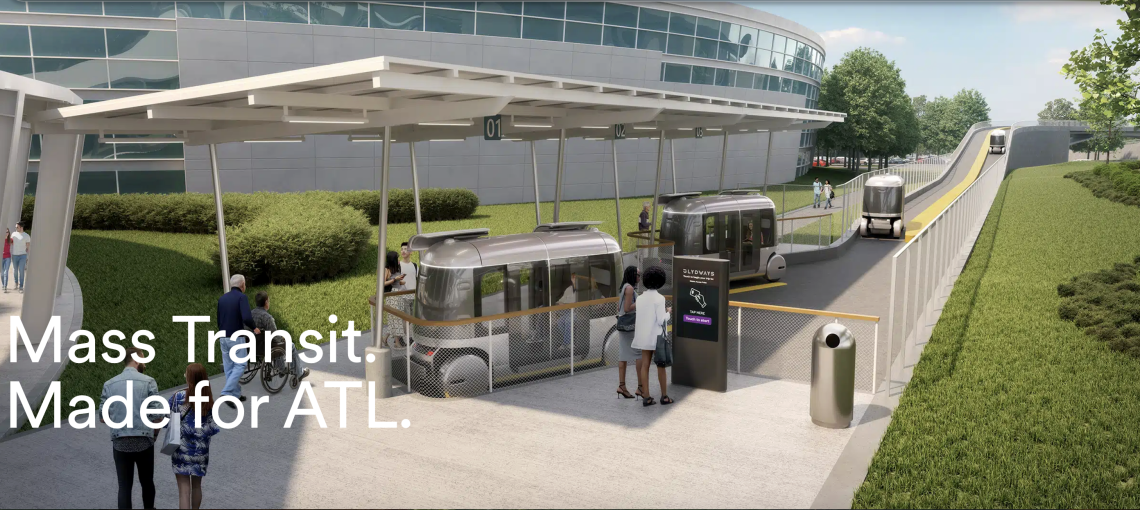 A rendering illustrating Glydways functionality at the convention center stop on ITP Atlanta's southside. Glydways.com
AACIDs officials compiled a feasibility study in 2019 and found that Personal Rapid Transit, or PRT, was one of three viable transportation alternatives for piloting, along with human-powered microtransit.
According to Harris, Glydways was picked after a “very competitive” RFP selection process that included seven interested parties and five official submissions. Local stakeholders and transportation officials also took exploration trips to see autonomous transit in action.
MARTA, meanwhile, is conducting a separate Automated Transit Network feasibility study, exploring possible ATN alignments to expand its airport transit network, per Harris.
What’s moving toward construction now? The initial autonomous vehicle route calls for a .5-mile guideway exclusively for Glydways shuttles that would connect the airport’s SkyTrain to the Georgia International Convention Center and Gateway Arena in College Park, and vice versa.
That route was determined by AACIDs, with cooperation from the City of College Park, per Harris.
 Plans for the pilot Glydways route in relation to Georgia International Convention Center. Glydways.com
A future alternative transit connection between the airport’s domestic and international terminals could also be in the works. The logic goes that the service could help solve a primary complaint from international passengers—that connecting to MARTA from the international terminal is too difficult, or what Glydways officials have called a “missing link.”
“We are still having conversations with [airport officials and] Delta and working with MARTA to determine future alignments,” noted Harris.
Harris says the pilot project is now set to begin construction in the first quarter of 2026. (Earlier projections called for breaking ground this year.)
According to Glydways, the two-year pilot project—with “live passenger service, testing scalability, performance, and community benefit”—is scheduled to begin next year, per the company.
An important note: Harris says a concept map that’s been circulated by Glydways leadership does not definitively reflect the area’s autonomous-vehicle future.
The illustration showed an expansive northern loop providing last-mile airport connectivity for southside cities such as Hapeville and East Point, along with Porsche's expanded North American Headquarters and possibly Clayton County. Porsche is against plans for self-driving vehicles near its property, and AACIDs doesn’t have full buy-in from other local partners, either. Airport officials have also indicated that a “southern loop” is preferable, says Harris.
...
Follow us on social media:
Twitter / Facebook/and now: Instagram
• Alternative transportation news, discussion (Urbanize Atlanta)