



Following years of discussion and planning revisions, the nearly $5-billion transformation of Ga. Highway 400 through some of metro Atlanta’s most high-growth areas is officially underway.
Tree-clearing work kicked off in recent weeks along a 16-mile section of the highway stretching from Sandy Springs up to Forsyth County—the first step toward construction of a $4.6-billion, tolled express lane overhaul with a Bus Rapid Transit component that links to MARTA rail.
As 11Alive News relays, Georgia Department of Transportation officials selected a private-sector partner—an LLC called SR 400 Peach Partners—to foot the bill, meaning taxpayers won’t be on the hook for financing construction, operations, or maintenance of the toll lanes project. The deal goes that the private group will reap almost all toll profits for 50 years, however, after which the project will become state property.
Parameters set by GDOT and the State Transportation Board of Georgia are governing how the project is implemented.
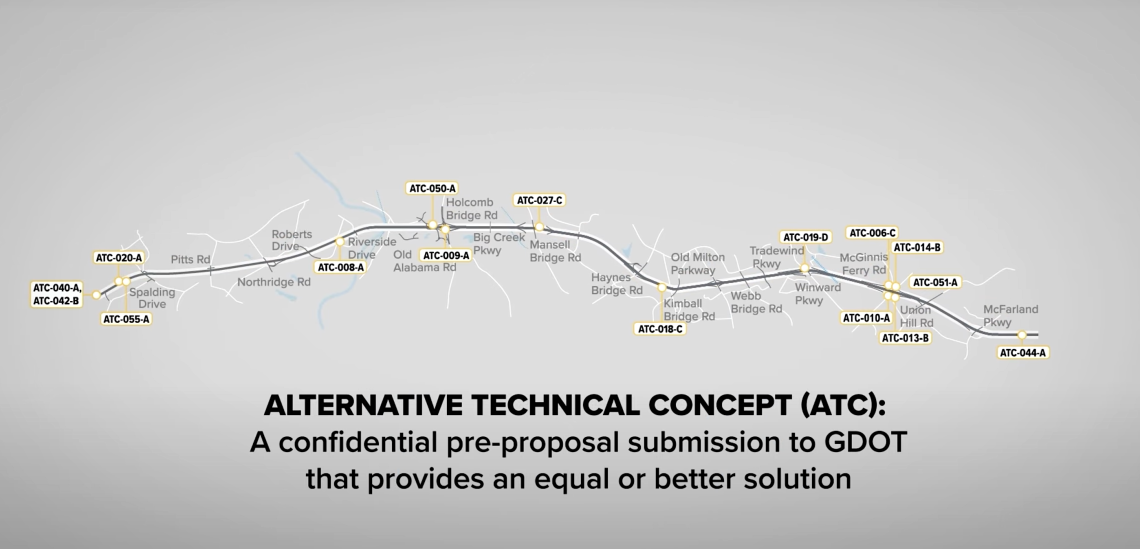 Overview of scope and key change points along the 16-mile construction route. GDOT/SR 400 Peach Partners
Expect changes that include multiple toll-lane entry and exit points along Ga. Highway 400 from North Springs MARTA Station (that’s Exit 5C) in Fulton County to roughly a mile north of McFarland Parkway (Exit 12) in Forsyth County. At the northern end, designs call for more streamlined access to planned megaproject The Gathering at South Forsyth, which is lobbying for a relocated National Hockey League franchise, according to GDOT and its partners.
For drivers, the Ga. Highway 400 toll lanes will operate with the Peach Pass’ variable pricing that, in theory, allows drivers to avoid congestion if they’re willing to pay for it. Rates will spike and dip based on real-time traffic conditions.
Designs call for two managed express lanes in each direction between MARTA’s North Springs station and just north of McFarland Parkway, all operating beside the current highway.
Beyond that, heading north, one toll lane in each direction will be implemented between McFarland Parkway and McGinnis Ferry Road for about a mile. Along the route, expect upgrades to existing bridges, including those at Kimball Bridge, Roberts Drive, and Pitts Road.
 Planned additional lanes just south of Holcomb Bridge Road near downtown Roswell. GDOT/SR 400 Peach Partners
Meanwhile, the planned BRT route will begin at MARTA’s North Springs station and head up to other MARTA services at the Windward Parkway Park and Ride in Alpharetta. (Notably, this means BRT transit won’t quite reach the area where an NHL team could relocate to metro Atlanta.)
Beyond the Sandy Springs MARTA station, BRT plans call for stops at Holcomb Bridge Road and near North Point Mall in Alpharetta. (Current BRT designs are more rudimentary than what MARTA had once envisioned for the key Ga. Highway 400 crossroads at Holcomb Bridge Road.)
All 16 miles of toll lanes and BRT routes will be constructed with enhanced concrete that limits maintenance needs and boosts driver safety, along with radar-monitored traffic and accident alerts, according to SR 400 Peach Partners.
 Slip ramps and BRT infrastructure planned at Holcomb Bridge Road. GDOT/SR 400 Peach Partners
Following tree-clearing work and cleanup, “heavy construction” on the project is scheduled to begin in the third quarter of 2026. GDOT and partners expect the new toll lanes to open sometime in 2031.
Find a step-by-step, exit-by-exit breakdown of the Ga. Highway 400 plans, beginning at the south end, over here.
...
Follow us on social media:
Twitter / Facebook/and now: Instagram
• OTP news, discussion (Urbanize Atlanta)